Quick Answer
마이너 돈키 트러블, officially titled Miner Donkey Trouble, is a Play’n GO cascading grid slot built around connected symbol clusters rather than conventional fixed paylines. Winning groups disappear, replacement symbols fall into the empty spaces, and the same paid round can continue through several cascades.
The main gameplay layer is the Donkey Destruction system. Winning symbols build progress toward increasingly disruptive grid-clearing effects, while Golden Nuggets, Diamond Wilds, the Miner’s Pickaxe, Dynamite Scatters, and free spins can alter how long a cascade sequence continues. Available sources commonly report high volatility and an RTP of up to 96.27%, although alternative RTP configurations may exist.
For readers in South Korea, understanding the game mechanics is separate from determining whether real-money online gambling is permitted. South Korea’s National Gambling Control Commission identifies unauthorized online reel games and online casino gambling among illegal gambling categories, so accessibility should not be treated as proof of legality.
Key Takeaways
- Gameplay revolves around connected symbol clusters and repeated cascades rather than standard left-to-right paylines.
- Winning symbols are removed, then new symbols fall into the grid, allowing the same paid round to continue.
- Donkey Destruction progresses through several levels based on the number of winning symbols collected during a sequence.
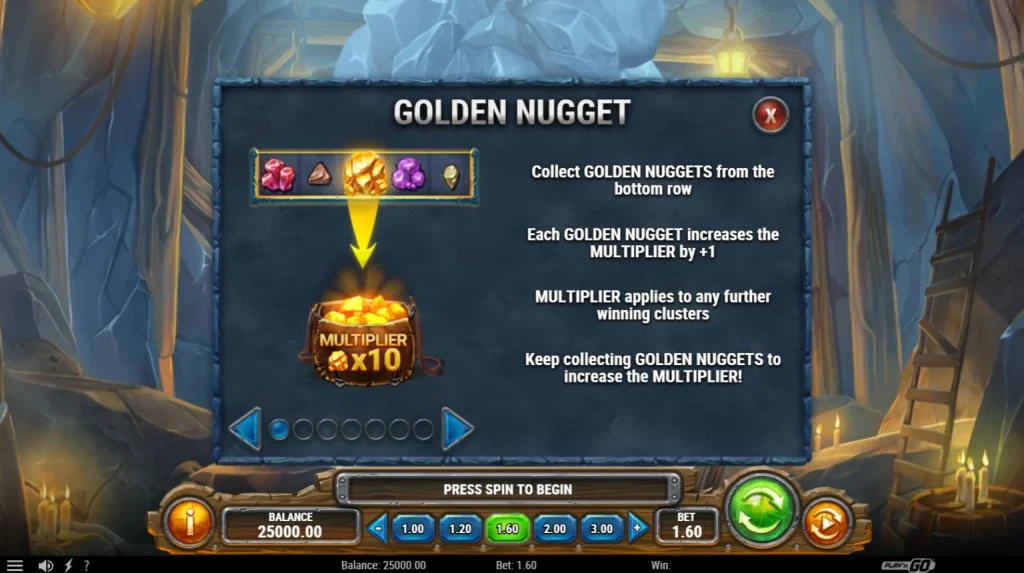
- Golden Nuggets contribute to a multiplier mechanic when they reach the required collection position.
- Dynamite Scatters can remove nearby symbols, introduce Wilds, and contribute toward triggering free spins.
- Published information commonly lists 96.27% RTP and high volatility, but the actual rules screen should be checked because different RTP configurations have been reported.
What It Means and How It Works
The basic rhythm is different from a conventional reel slot. Instead of waiting for matching symbols to line up across fixed paylines, the game looks for connected groups of matching symbols. Published rule descriptions state that clusters generally require at least five matching symbols connected horizontally or vertically.
When a qualifying cluster forms, those symbols are removed. Symbols above them drop into the empty spaces, and additional symbols enter the grid. If the replacement layout creates another cluster, another win is evaluated without requiring a completely separate initial spin.
This cascading structure gives the game a stop-and-start rhythm. A paid round may end after the first evaluation, or one successful cluster can begin a longer chain in which the grid repeatedly clears and refills.
That cascade-focused design is characteristic of the broader grid-slot mechanics found within Play’n GO’s game portfolio, although individual Play’n GO titles can use very different feature systems.
Donkey Destruction
Every winning cluster also contributes winning symbols toward the Donkey Destruction feature.
Published rules describe three thresholds:
- Donkey Destruction 1: reached after 18 winning symbols, removing rock symbols from the grid.
- Donkey Destruction 2: reached after 40 winning symbols, removing rock and gem symbols.
- Donkey Destruction 3: reached after 50 winning symbols, clearing most symbols while preserving Golden Nuggets and potentially introducing additional Nuggets.
These effects matter because removing large groups of symbols changes the entire grid at once. The result is less about making a decision and more about watching how one successful cascade sequence develops.
Donkey Destruction effects can also be queued. According to available rules descriptions, an earned destruction effect activates once the current visible wins have finished, after which the round can continue.
Golden Nuggets and the Multiplier
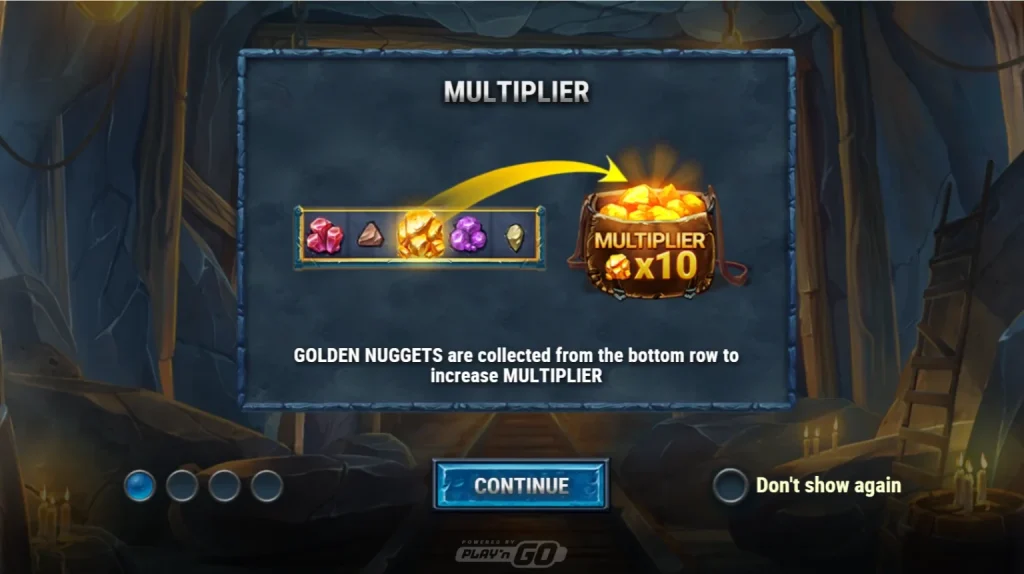
Golden Nuggets function differently from ordinary paying symbols.
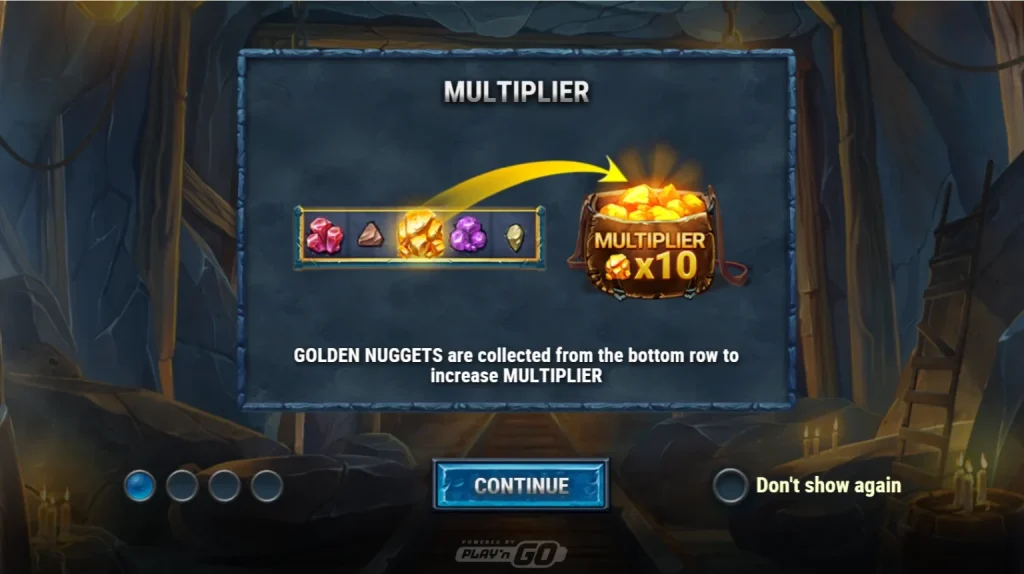
Available game descriptions indicate that Nuggets need to reach the collection area at the bottom of the grid. A collected Nugget raises the multiplier by one step for the ongoing sequence.
This makes long cascade chains important to the game’s pacing. A Nugget appearing near the top of the grid does not automatically produce its full effect. Grid movement and symbol removal can gradually bring it toward the collection position.
The practical result is a feature that rewards extended cascade development rather than changing the probability of the next independent spin.
Miner’s Pickaxe and Diamond Wilds
The Miner’s Pickaxe is another grid-altering feature.
Secondary rule descriptions report that collecting or activating the Pickaxe introduces between four and ten Diamond Wild symbols at random positions. Those Wilds can substitute for regular symbols and potentially create or enlarge connected clusters.
From a gameplay perspective, this creates sudden changes in grid density. A layout that initially appears fragmented can gain several Wild positions before the next cascade evaluation.
The combination of cascading symbols, Wild generation, and destruction mechanics illustrates why Play’n GO feature terminology should be read title by title rather than assuming every game from the provider follows the same structure.
Dynamite Scatters and Free Spins
Dynamite is tied to both symbol removal and the free-spin sequence.
Available descriptions state that a Dynamite Scatter explodes, removes nearby symbols, and leaves Diamond Wilds behind. Collecting three Dynamite Scatters within the relevant sequence triggers five free spins.
The free-spin feature retains more of the game’s accumulating feature structure than a basic reset-every-spin bonus. Published descriptions indicate that the multiplier does not reset between free spins, which can make the bonus sequence feel progressively more volatile as Nuggets are collected.
This does not mean later spins are guaranteed to pay more. It means the multiplier mechanic can remain active across the feature rather than necessarily returning to its starting level after every free spin.
What to Check in the Game Rules Screen
The rules screen is especially important for this title because several published statistics can differ by implementation.
RTP Setting
A commonly reported RTP figure is 96.27%. Multiple independent game databases and reviews list that value, but some sources also report lower configurable versions.
RTP is a theoretical long-run calculation across a very large number of plays. It does not mean a player should expect 96.27% of an individual session’s wagers to return.
Check the actual RTP displayed within the loaded game rather than assuming the highest published figure is being used.
Understanding how Play’n GO RTP disclosures are presented also helps separate a mathematical specification from short-term gameplay results.
Cluster Requirements
Verify how the rules define a valid cluster.
Published descriptions generally specify five or more matching symbols connected horizontally or vertically. Unlike a conventional slot, diagonal adjacency alone does not necessarily form a qualifying group.
This changes how the grid should be read. The number of visible matching symbols matters less than whether they are actually connected according to the rules.
Grid Configuration
Sources are not completely consistent when describing the visible grid dimensions. Several contemporary descriptions identify Miner Donkey Trouble as a 5-by-7 cascading format, while other published materials describe it differently.
Because the game’s internal rules determine the actual configuration being offered, the live information screen should take priority over review-site summaries.
Donkey Destruction Thresholds
Check that the version being played uses the published 18, 40, and 50 winning-symbol thresholds.
These thresholds affect how rapidly the feature meter can advance during a productive cascade sequence. They are therefore more relevant to gameplay feel than a generic description such as “bonus feature.”
Maximum Win and Feature Limits
Published material commonly reports a maximum win of up to 10,000 times the stake.
Any cap shown in the actual game rules should be treated as authoritative for that implementation.
The same applies to retriggers, Wild generation ranges, multiplier behavior, and free-spin limits. These details determine how far an extended feature sequence can progress.
Volatility
Miner Donkey Trouble is widely described as high volatility.
High volatility generally means outcomes can be unevenly distributed, with stretches of relatively small or absent returns interrupted by larger feature-driven movements.
Volatility does not forecast when either type of result will occur.
Players comparing mechanics across Play’n GO games should therefore distinguish volatility classification from RTP. One describes the distribution and variation of results, while the other describes a long-run theoretical return.
Quick Reference
| Element | What to Verify | Why It Changes Gameplay |
|---|---|---|
| Win system | Connected cluster requirements | Determines which matching symbols actually count |
| Cascades | Winning-symbol removal rules | Controls whether one paid round can continue |
| Donkey Destruction | 18, 40, and 50-symbol thresholds | Changes when large grid-clearing effects activate |
| Golden Nuggets | Collection position and multiplier behavior | Affects multiplier progression during cascades |
| Dynamite Scatter | Explosion, Wild, and trigger rules | Alters the grid and contributes to free spins |
| RTP | Exact percentage in the current game | Published versions may differ |
| Volatility | Provider or rules-screen classification | Helps explain the expected degree of result variation |
Common Mistakes and Misconceptions
Assuming Every Cascade Makes the Next One More Likely
A cascade can alter the grid dramatically, but it does not create a guaranteed continuation.
When symbols disappear and replacements fall into place, another cluster may form or the sequence may stop immediately.
The visual momentum of several consecutive cascades can make the sequence feel as though it is “building toward” another win, but animation and recent results do not predict what the random outcome generator will produce next.
Treating the Donkey Destruction Meter as a Guaranteed Payout
Donkey Destruction clears symbols and changes the grid configuration.
That can create additional opportunities for clusters, but triggering the feature is not itself a guarantee that a particular payout will follow.
The effect modifies the current grid. It does not override random outcomes.
Reading 96.27% RTP as a Session Forecast
An RTP figure such as 96.27% is not a promise that every 100 units wagered will produce 96.27 units back during one session.
Short-term outcomes can finish far above or below the theoretical percentage because of variance.
This distinction becomes especially important in high-volatility games, where short sessions can produce unusually uneven results.
Believing a Long Losing Sequence Makes a Win Due
Previous independent outcomes do not create a mathematical obligation for the next result to compensate for earlier losses.
This is the gambler’s fallacy.
A run of unsuccessful spins can feel statistically unusual without making a particular outcome “due.”
Confusing Feature Progress with Predictability
Seeing a Donkey Destruction meter advance or a Golden Nugget move toward the bottom row gives the player visible information about the current feature state.
It does not reveal the outcome of future random symbol drops.
The useful distinction is between known feature state and unknown future result.
Example of a Cascade Sequence
Suppose a spin forms a connected group of six matching symbols.
Those six symbols are evaluated as a cluster and removed. Six replacement positions are then filled as symbols fall downward.
If the new arrangement creates another qualifying cluster, those symbols are removed as well.
Both groups also contribute winning symbols toward Donkey Destruction progress. If one or more Golden Nuggets move into the collection position during the sequence, the active multiplier may increase according to the game’s rules.
If no additional cluster or queued feature remains, the cascade sequence finishes.
The important point is that a single initial spin can contain several internal stages without those stages representing several independent wagers.
Responsible Gambling Note
Miner Donkey Trouble combines high-volatility behavior with cascading wins, persistent feature meters, multipliers, and bonus sequences. Those mechanics can make individual rounds feel longer and more eventful than conventional reel spins.
Session limits should therefore be based on time and money decided independently of recent results. Increasing stakes after losses does not improve the probability of recovery, and an accumulating feature should not be treated as a reason to exceed a predetermined limit.
For South Korea readers, gameplay information should also be separated from legal access. The National Gambling Control Commission identifies unauthorized online casino and online reel gambling among illegal gambling activities.
FAQ
What type of slot is 마이너 돈키 트러블?
It is a Play’n GO cascading grid slot using connected clusters rather than conventional fixed paylines. Winning symbols disappear and replacement symbols fall into the cleared spaces, potentially producing additional clusters during the same round.
What is the RTP of 마이너 돈키 트러블?
The most commonly published RTP is 96.27%. However, secondary sources report that different RTP configurations can exist, so the percentage displayed in the current game’s rules should be checked rather than assuming every version uses 96.27%.
Is 마이너 돈키 트러블 a high-volatility game?
Yes. Multiple published game descriptions classify it as high volatility. In practical terms, that means results can be distributed unevenly, with potentially substantial differences between quiet periods and feature-heavy sequences. It does not indicate when either type of outcome will occur.