Quick Answer
리액툰즈 2, officially titled Reactoonz 2, is a PLAY’n GO grid slot built around cascading cluster wins and two visible progression systems, the Fluctometer and Quantameter. PLAY’n GO identifies it as a grid slot released on October 1, 2020.
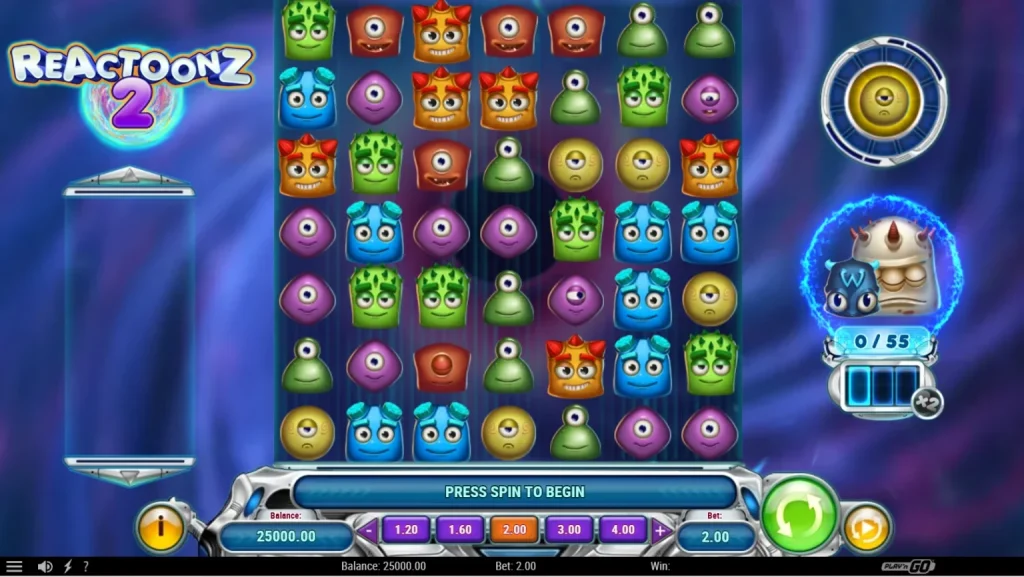
Instead of following fixed paylines, the action takes place on a 7×7 grid where connected matching symbols can form winning clusters. Winning symbols disappear, replacements fall into the cleared spaces, and another cluster can form before the sequence ends. This gives individual rounds a stop-and-start rhythm in which a single initial result can develop into several consecutive cascades.
For readers in South Korea, this page should be treated strictly as an educational explanation of game mechanics. Korean criminal law generally restricts gambling, apart from the statutory exception for gambling considered a mere pastime, so availability elsewhere does not establish that real-money play is lawful in South Korea.
Key Takeaways
- Reactoonz 2 uses a 7×7 grid and cluster-based wins rather than conventional left-to-right paylines.
- Winning clusters disappear and new symbols fall into their places, potentially producing several cascades from one round.
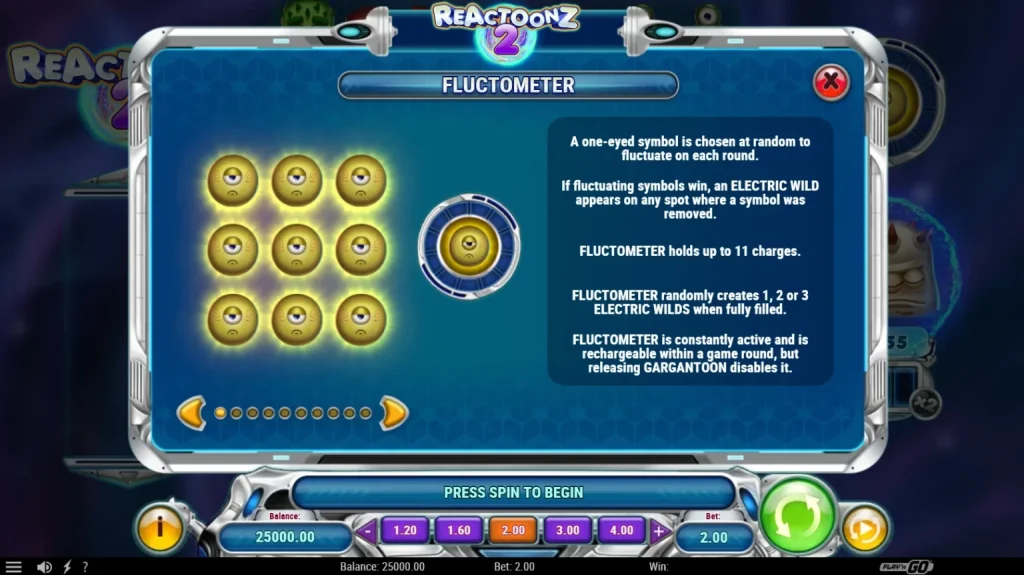
- The Fluctometer builds from wins involving a highlighted one-eyed symbol and can introduce Electric Wilds.
- Electric Wild activity contributes to the Quantameter, which progresses toward Energoon and Gargantoon Wild features.
- A secondary rules source reports a 96.20% default RTP alongside several lower configurations, so the RTP displayed in the actual rules screen should be checked rather than assumed.
- The same secondary source classifies the game as high volatility, meaning results can be uneven over short sessions even when the long-run RTP is known.
What It Means and How It Works
Reactoonz 2 belongs to PLAY’n GO’s grid-slot format, so the screen behaves less like five conventional spinning reels and more like a board that continually reorganizes itself after successful clusters. The broader design context of PLAY’n GO casino games helps explain why the game is better understood through its interacting meters and Wild mechanics than through traditional paylines.
A winning cluster requires at least five matching symbols connected horizontally or vertically. Once a cluster qualifies, its symbols disappear. Existing symbols drop downward and new ones enter the empty positions. If those replacements form another qualifying cluster, another cascade follows. The process stops when the new grid no longer produces a win.
That cascading structure changes the pace of play. A round may finish immediately after the first evaluation, or it may stretch through several linked removals and refills. The important distinction is that additional cascades are consequences of the current round, not evidence that the next independent round has become more likely to pay.
Fluctometer
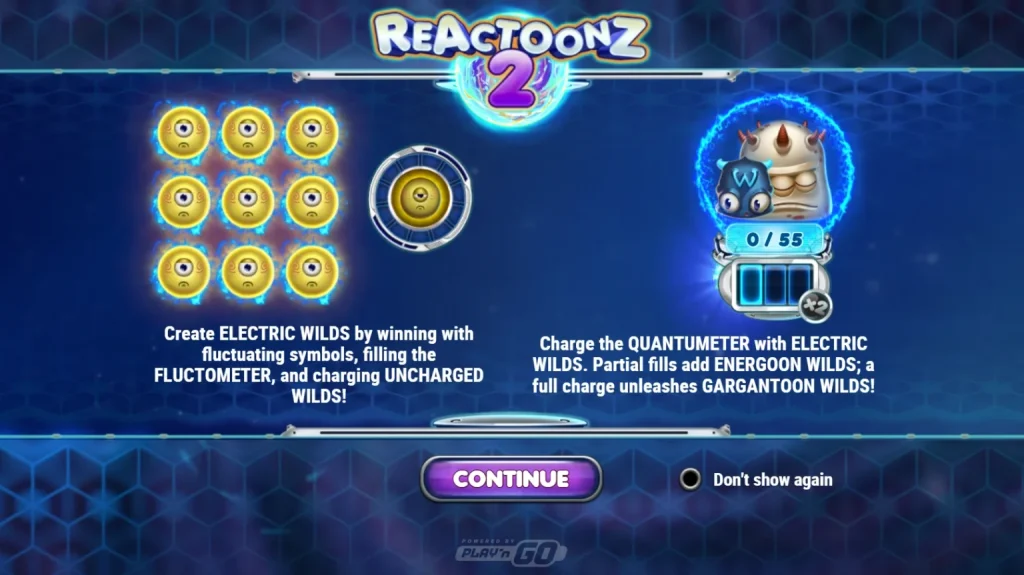
During each round, one of the one-eyed Reactoonz symbols receives the fluctuation effect. Wins involving that symbol add energy to the Fluctometer. According to the detailed secondary rules description, the meter can build to 11 units and, when filled, releases between one and three Electric Wilds after the cascade sequence finishes.
From a gameplay perspective, this gives some clusters a second purpose. They may produce their ordinary payout while also advancing a visible feature meter.
Electric Wilds and the Quantameter
Electric Wilds connect the game’s two progression systems. PLAY’n GO states that winning with fluctuating symbols fills the Fluctometer, which can create Electric Wilds, while Electric Wild activity contributes energy toward the Quantameter. Partial Quantameter progress can add Energoon Wilds, while a full charge can release the larger Gargantoon Wild.
The resulting flow can shift from relatively simple cluster clearing into a denser sequence of Wild placements, symbol removals, meter movement, and further cascades. This layered progression is characteristic of the more feature-driven titles covered within PLAY’n GO game mechanics.
Gargantoon and Energoon Wilds
The detailed game description reports that Energoon Wilds can appear as single Wilds or as a larger 2×2 formation. Gargantoon occupies a 3×3 area and can break into smaller Wild sections as successful cascades continue.
These expanding and breaking Wild structures matter because they can influence several adjacent grid positions simultaneously. They do not change the principle that outcomes remain uncertain, but they can make an active cascade visually and mechanically more complex.
What to Check in the Game Rules Screen
The rules screen is more useful than relying on a generic game review because casino game configurations can vary between deployments.
Confirm the displayed RTP
A secondary source lists 96.20% as the default RTP while also reporting lower configurations of 94.20%, 91.20%, 87.20%, and 84.20%. PLAY’n GO’s public product page does not publish those RTP figures, so the percentage shown in the specific version’s information or rules panel should take precedence.
RTP describes a mathematical return calculated across a very large volume of play. It does not state what one player will receive during a particular session.
Confirm how cluster wins are defined
Check the minimum cluster size and what counts as adjacency. The published description states that Reactoonz 2 requires at least five matching symbols connected vertically or horizontally.
Understanding this makes the grid easier to read because diagonal symbols alone do not necessarily belong to the same cluster.
Read the Fluctometer wording
The Fluctometer is central to the rhythm of the game. Check which symbol is currently fluctuating, how progress is awarded, and what happens once the meter fills.
Knowing the trigger conditions helps distinguish ordinary clusters from clusters that also move the feature system forward.
Read the Quantameter thresholds
The secondary rules description identifies several Quantameter thresholds that produce different Wild effects, culminating in Gargantoon and an overcharged state.
Exact feature wording should still be verified inside the version being viewed. PLAY’n GO slot features provides broader context for interpreting provider-specific terminology without treating feature progress as a prediction of future results.
Check maximum payout information
Maximum-win figures describe a mathematical cap, not an expected result. AboutSlots reports a maximum of 5,083 times the stake for the version it reviewed.
A high maximum should not be interpreted as information about how frequently such an outcome occurs.
Quick Reference
| Element | What to verify | What it changes during gameplay |
|---|---|---|
| Grid | 7×7 layout | More positions interact than in a conventional five-reel layout |
| Cluster rule | Minimum matching symbols and adjacency | Determines when symbols qualify as a win |
| Cascades | Removal and refill sequence | A single round may contain several consecutive evaluations |
| Fluctometer | Highlighted symbol and charge rules | Certain winning symbols can advance a feature |
| Quantameter | Charge thresholds | Progress can introduce larger Wild features |
| RTP | Percentage shown in the current rules screen | Describes long-run theoretical return, not session results |
| Volatility | Disclosed classification, if available | Indicates how unevenly returns may be distributed |
Common Mistakes and Misconceptions
Treating meter progress as a promise of profit
Visible meters create a strong sense of progression, but progression toward a game feature is not the same as progression toward a profitable session. A meter can trigger a Wild mechanic without producing a result larger than the money already risked.
Assuming RTP predicts a short session
A 96.20% RTP, where that configuration applies, does not mean a player should expect to retain exactly 96.20% of a stake during a short sequence of rounds.
RTP is a long-run mathematical measure. Actual short-term results can sit far above or below that percentage because of variance.
Assuming a losing sequence makes a win due
Several unsuccessful rounds do not make the next round more likely to produce a cluster or major feature. Treating previous outcomes as evidence that a future win is “due” is the gambler’s fallacy.
Confusing volatility with RTP
RTP concerns theoretical long-run return. Volatility concerns how results tend to be distributed.
A game can have an RTP similar to another slot while producing a very different session experience. A higher-volatility game may concentrate more of its mathematical return into less frequent or more variable outcomes.
Assuming every Reactoonz 2 version has identical settings
Game titles can exist in multiple mathematical configurations. The reported availability of several RTP versions is why the actual rules screen matters more than a single figure copied from a review.
The broader PLAY’n GO provider overview can establish common terminology, but the information displayed inside the specific game version remains the relevant reference for its configuration.
Examples
Suppose a round begins with a cluster of matching one-eyed symbols that are currently affected by the Fluctometer. The cluster disappears, the meter gains progress, and replacement symbols fall into the empty spaces.
If the replacement symbols create another cluster, the cascade continues. That sequence can make one round feel considerably longer than a round where the opening grid contains no qualifying cluster.
The same visual momentum should not be interpreted as evidence about the result of the next round.
Similarly, two versions of Reactoonz 2 could display the same graphics and features while using different disclosed RTP settings. Their interfaces may look nearly identical, but their long-run mathematical configurations would not be identical if different RTP versions are active.
Responsible Gambling Note
Reactoonz 2 combines cascading outcomes, persistent-looking meters, animated Wilds, and high-volatility characteristics, all of which can make individual sequences feel more significant than they are mathematically.
Session length and spending limits should therefore be set independently of recent wins, losses, meter progress, or the belief that a feature is about to compensate for earlier results. PLAY’n GO states that its games can support gameplay limits and in-play timers when those controls are activated by the casino operator and configured by the player.
For South Korean readers, responsible play also includes checking applicable local law before engaging in any real-money gambling activity. Article 246 of South Korea’s Criminal Act generally penalizes gambling, subject to its limited statutory exception for mere pastime gambling.
FAQ
Is 리액툰즈 2 a normal payline slot?
No. PLAY’n GO classifies Reactoonz 2 as a grid slot, and published game information describes a 7×7 cluster-paying layout. Matching symbols form qualifying groups through horizontal or vertical adjacency rather than conventional left-to-right paylines.
What do the Fluctometer and Quantameter do?
The Fluctometer gains energy from wins involving the currently fluctuating one-eyed symbol and can introduce Electric Wilds. Electric Wild activity then contributes toward the Quantameter, which can release Energoon Wilds and eventually the larger Gargantoon Wild.
What is the RTP of Reactoonz 2?
AboutSlots reports a default RTP of 96.20% and several lower variants. Because multiple configurations are reported, the safest interpretation is to verify the RTP shown in the rules or information panel of the specific version being examined. RTP is a long-run theoretical percentage and does not predict the outcome of an individual session.