Quick Answer
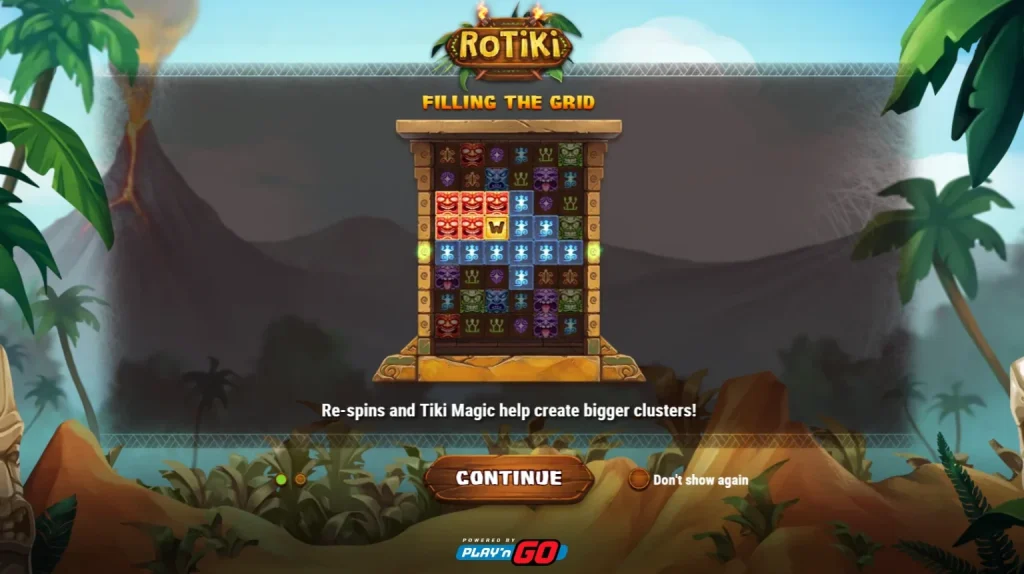
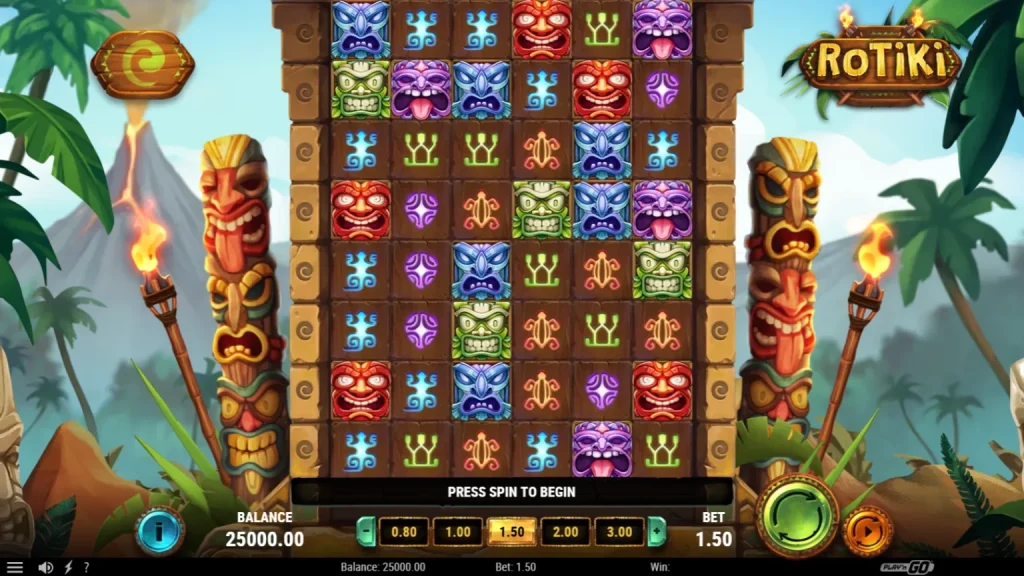
로티키, officially titled Rotiki, is a Play’n GO grid slot built around cluster wins and extended respin sequences rather than conventional paylines. Five or more matching symbols connected horizontally or vertically form a cluster, and the first qualifying cluster begins a sequence in which winning symbols remain while other positions refresh.
The result is gameplay that feels more like gradually building a full grid than repeatedly starting from zero. Successful sequences can expand clusters, activate special wild effects, and eventually reach the Treasure Room bonus if the grid is filled with winning symbols. Play’n GO lists Rotiki as a grid slot released on July 14, 2022.
Key Takeaways
- Rotiki uses a 6 by 8 grid and cluster-based wins rather than standard paylines. Third-party documentation describes wins as five or more matching symbols connected horizontally or vertically.
- A winning cluster starts a respin sequence, so one paid spin can develop through several grid changes before the round ends.
- Winning symbols remain in position while other symbols move or refresh, creating a slower, build-and-expand rhythm than a conventional cascading slot.
- Tiki Magic effects can alter qualifying clusters through symbol upgrades or cluster merging.
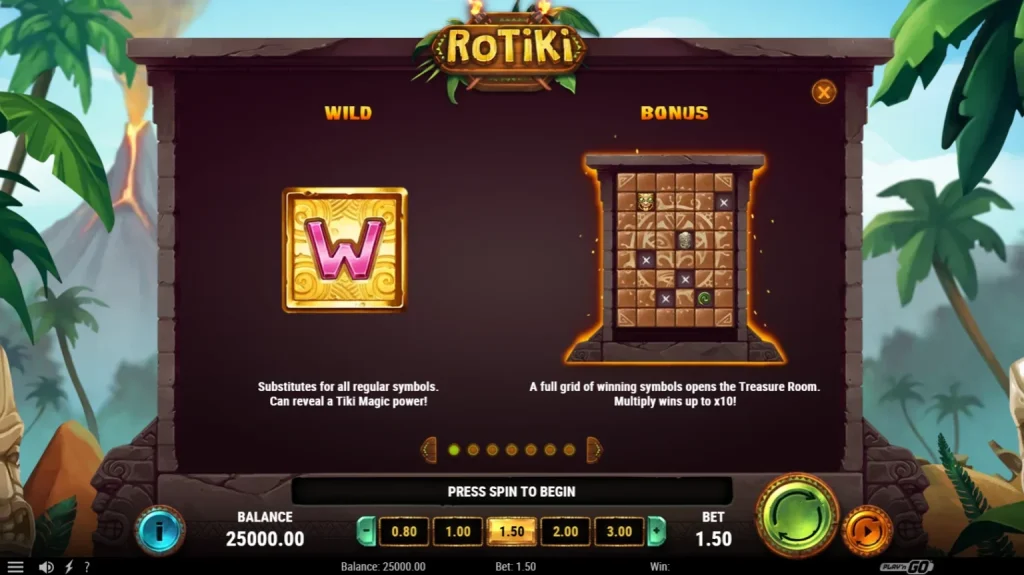
- Filling the grid with winning symbols leads to the Treasure Room, a separate pick-style feature involving multiplier effects.
- Published RTP and volatility information should be checked in the actual game rules. Third-party sources agree on a commonly listed 96.20% RTP but disagree on the volatility classification.
What It Means and How It Works
Rotiki’s central idea is persistence. In many slots, a completed spin clears the reels and the next spin begins with an entirely new arrangement. Rotiki instead allows a winning result to develop through additional respins.
The round begins on a 48-position grid. Matching groups need at least five connected symbols to form a cluster. When that happens, the qualifying symbols stay involved while the remaining positions move again. Play’n GO describes the visual movement as blocks rotating from left to right rather than using the familiar downward cascade seen in many grid slots.
That distinction strongly affects the feel of play. Instead of watching symbols disappear and fall into empty spaces, the player sees a winning formation remain relevant while the surrounding grid changes. A modest cluster can therefore become the starting point for a longer sequence rather than simply ending with its initial payout.
The broader Play’n GO game portfolio includes several different slot structures, but Rotiki is specifically designed around this cluster-and-respin rhythm.
Building the Respin Sequence
Play’n GO states that the first qualifying cluster triggers three re-spins. Further developments can continue filling the grid row by row with matching symbols, with the long-term feature objective being a completely filled grid.
This creates a noticeable change in pacing whenever a cluster lands. A non-winning spin resolves quickly. A winning spin may instead pause the normal rhythm and shift into a more deliberate sequence where each refresh can extend the existing formation.
The important point is that a respin sequence is still governed by random outcomes. The presence of an established cluster does not guarantee that the grid will continue expanding.
Tiki Magic Effects
Third-party game documentation identifies two Tiki Magic effects, Whakarei and Hanumi.
Whakarei can upgrade symbols within an affected cluster to a higher-value mask symbol. Hanumi can merge qualifying clusters and use the higher-paying eligible symbol type for the resulting combined cluster.
From a gameplay perspective, these mechanics matter because they can change the structure of an active cluster without requiring the player to make a strategic decision. The player mainly watches how the grid changes and whether those changes help extend the current respin sequence.
This feature-heavy presentation is consistent with the kind of terminology readers may encounter across Play’n GO slots and game mechanics, although feature names and mathematical models differ from game to game.
Reaching the Treasure Room
Play’n GO describes the Treasure Room as the bonus feature reached by clearing or filling the grid with winning symbols. The feature changes the format from grid building to an interactive pick sequence in which hidden selections can affect a multiplier.
Third-party documentation adds that the number of available selections can depend on unused respins carried into the feature, while some hidden tiles increase the multiplier or award additional picks.
The transition is easy to recognize during play. The repeated grid expansion stops, and the game moves into a separate bonus screen with a different pace and presentation.
What to Check in the Game Rules Screen
Rotiki has enough moving parts that the rules screen is more useful than relying on a summary from another website. This is particularly important for South Korea readers viewing informational material because game availability and lawful gambling access depend on local regulation, and the National Gambling Control Commission identifies unauthorized online casino gambling as illegal gambling activity.
RTP Disclosure
Check the RTP figure displayed in the version of Rotiki being viewed.
Several third-party sources list 96.20% as the standard or default RTP, but at least two also report that lower mathematical configurations may exist.
RTP describes a theoretical long-run return across a very large number of game rounds. It does not indicate what will happen during one session, one hundred spins, or any other short sample.
The Play’n GO provider overview can provide broader context for interpreting provider documentation, but the rules screen inside the specific game remains the relevant source for the version actually being examined.
Cluster Requirements
Confirm that the rules specify how symbols must connect.
Available Rotiki documentation describes wins as groups of five or more identical symbols linked horizontally or vertically. Diagonal proximity by itself should not be assumed to qualify unless the game’s own rules state otherwise.
Understanding this makes the grid easier to read. Large areas of the same symbol can look substantial while still behaving differently depending on whether the required connections are actually present.
Respin Conditions
Review exactly when respins begin, how many are initially awarded, and what extends the sequence.
Rotiki’s respins are central to its gameplay identity. Knowing their conditions helps explain why some winning rounds end quickly while others develop into longer chains.
Tiki Magic Labels
Check the current wording for Whakarei, Hanumi, wild behavior, and any restrictions attached to special symbols.
Feature summaries from review sites can be useful for orientation, but the in-game help material should take priority if wording or implementation differs.
Maximum Payout
Play’n GO states that Rotiki has an opportunity for a result of up to 1,000 times the bet.
That figure is a maximum possible game outcome, not an expected session result. It does not indicate how frequently a particular player will encounter it.
Volatility
Treat third-party volatility labels cautiously.
Fruity Slots currently describes Rotiki as medium volatility, while All Slots Online describes it as high volatility.
Because those descriptions conflict, it is more accurate to verify whether the current game rules provide an official volatility designation rather than repeating one external label as definitive.
Quick Reference Table
| Gameplay element | What to verify | What it changes during play |
|---|---|---|
| Grid | 6 reels by 8 rows | Creates a large field for connected clusters |
| Win condition | 5 or more connected matching symbols | Determines when a respin sequence starts |
| Respin mechanic | Initial and additional respin conditions | Controls how long one winning round can develop |
| Tiki Magic | Whakarei and Hanumi behavior | Can upgrade or combine active clusters |
| Treasure Room | Full-grid trigger and pick rules | Changes the game from grid play to a pick feature |
| RTP | Percentage shown in the current rules | Describes theoretical long-run return, not session results |
| Maximum payout | Current game cap | Defines the upper mathematical limit of a single game outcome |
Common Mistakes and Misconceptions
Treating RTP as a Session Prediction
An RTP figure such as 96.20% does not mean a player should expect to receive 96.20% of their stake back during a particular session.
RTP is calculated over very large numbers of theoretical or simulated game rounds. Short sessions can finish substantially above or below that long-run figure.
Assuming a Long Respin Sequence Is “Due”
A respin chain may visually appear to be approaching a full-grid result, but that does not make the missing symbols more likely to arrive because the sequence has lasted a certain amount of time.
This is a form of gambler’s fallacy. Previous random outcomes do not create an obligation for the next random event to complete a feature.
Confusing Large Clusters With Large Payouts
Rotiki can display visually large blocks of matching symbols. That does not automatically mean the payout will be proportionally large.
The symbol type, cluster size, modifiers, multipliers, and applicable paytable rules determine the actual result.
Assuming Volatility Has One Universally Published Value
Third-party Rotiki pages currently disagree about whether the game should be described as medium or high volatility.
Volatility terminology is also descriptive rather than predictive. Even when a game is formally classified as high, medium, or low volatility, that classification does not forecast the outcome of the next spin.
Believing a Betting Pattern Changes the Random Mechanic
Increasing, decreasing, or alternating stake sizes does not create a reliable way to trigger Rotiki’s Treasure Room, Tiki Magic effects, or cluster sequences.
The gameplay features may create recognizable patterns on screen, but those patterns do not form a dependable winning system.
Example of a Rotiki Round
Consider a simplified example in which five matching mask symbols connect on the grid.
That cluster qualifies as a win and begins the respin process. The matching symbols remain relevant while other positions refresh. If additional matching symbols connect to the existing formation, the cluster may grow and the round can continue.
A Tiki Magic effect could then alter the arrangement by upgrading symbols or combining qualifying clusters. If the sequence eventually fills the required grid positions, the game moves into the Treasure Room.
If the new symbols fail to extend the sequence under the game’s rules, the respins end.
The important distinction is that each stage changes the presentation and possible payout calculation, but none guarantees that the next stage will occur.
Responsible Gambling Note
Rotiki’s respin structure can make individual rounds feel longer than a conventional one-spin result because a single paid spin may develop through several subsequent grid events. That makes tracking time and total spending more useful than counting only the number of visible respins.
Set a fixed spending limit and session limit before playing any real-money gambling game. Do not increase stakes to recover previous losses, and do not interpret extended losing or winning sequences as evidence that a particular result is about to occur.
For readers in South Korea, legality is also an important practical consideration. The National Gambling Control Commission explicitly categorizes unauthorized online casino and internet gambling activities among forms of illegal gambling and maintains prevention and treatment measures addressing gambling-related harm.
FAQ
Is Rotiki a paylines slot?
No. Rotiki is officially described by Play’n GO as a grid slot, and available game documentation describes its wins through connected clusters rather than fixed paylines.
What makes Rotiki different from a normal cascading slot?
The most visible difference is the movement of the grid. Play’n GO states that symbols move from left to right with rotating blocks instead of using a standard downward cascade. Combined with sticky winning symbols and respins, this gives Rotiki a more gradual cluster-building rhythm.
What triggers the Treasure Room in Rotiki?
Play’n GO states that filling or clearing the grid through the cluster sequence leads to the Treasure Room bonus. The feature then becomes a pick-style round in which hidden selections can affect the multiplier.