Quick Answer
로지 오빗 트레져 턴, officially titled Rosy Orbit Treasure Turn, is a Play’n GO 5×5 cascading slot built around a rotating-grid mechanic. After a winning combination is removed, the Treasure Turn feature rotates the grid 90 degrees counter-clockwise. The remaining symbols then shift under gravity, new symbols enter, and another win may continue the sequence.
The game combines 3,125 win ways with oversized 2×2 symbols, symbol-crushing multipliers, random Starfall events, and a free-spins round. Play’n GO describes the pace as comparatively gentle, but the rotating grid makes successful sequences more spatial and less predictable than a conventional reel cascade.
Published specifications commonly list a highest RTP configuration of 96.20%, medium volatility, a 21.69% hit frequency, and a maximum payout cap of 6,000 times the bet. Several lower RTP configurations have also been documented, so South Korean readers should treat the local rules screen as the controlling source rather than assuming every version uses 96.20%.
Key Takeaways
- The main mechanic activates after a win and rotates the complete 5×5 grid before the cascade continues.
- Large symbols occupy a 2×2 area but are treated as a single symbol instance when wins are evaluated.
- Large symbols can crush smaller symbols and gain multipliers from the crushed positions.
- Starfall can remove symbols or add Wilds while a Treasure Turn sequence is active.
- Three Scatter symbols award eight free spins, based on the reviewed game information.
- Documented RTP versions range from 84.20% to 96.20%, making version checking important.
- PC, Mobile, and PC Online versions may present the controls differently, but device type should not be assumed to change the mathematics.

What 로지 오빗 트레져 턴 Means
The title refers to a cosmic-themed grid slot in which the central play area physically changes orientation after a successful result. Instead of symbols only dropping vertically into empty spaces, the entire matrix turns before gravity takes effect again.
This rotation is the defining gameplay difference. A normal cascade usually preserves the direction of the grid. In 로지 오빗 트레져 턴, every winning removal can change which symbols sit above, below, or beside one another.
That movement creates a soft but visually active rhythm. A spin may end immediately when no win forms, while a successful spin can become a longer sequence of removal, rotation, falling symbols, new arrivals, and another evaluation.
The broader Play’n GO game mechanics overview helps place this rotating-grid design alongside the provider’s conventional reel slots, grid games, and cascading formats.
How the Gameplay Works
Starting the Spin
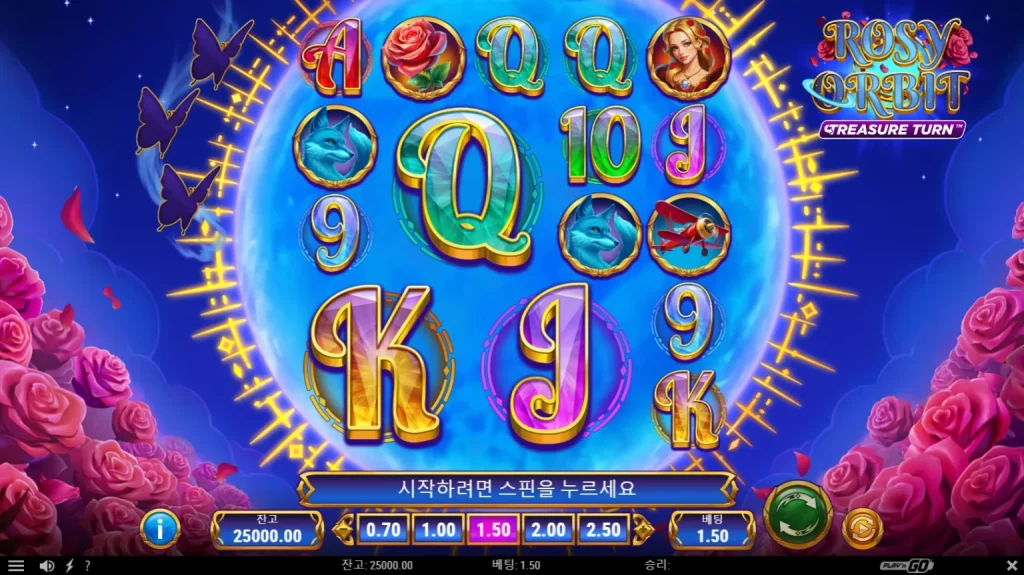
The base game uses a 5×5 grid with 3,125 advertised ways to win. Published reviews describe qualifying combinations as groups of at least three matching symbols on adjacent reels, beginning from the leftmost reel.
The player selects a total bet and starts the spin. The game then checks the completed grid for a qualifying combination.
A losing spin stops without activating the main movement sequence. A winning spin begins the Treasure Turn process.
Treasure Turn
After a win:
- The winning symbols disappear.
- The grid rotates 90 degrees counter-clockwise.
- Remaining symbols slide into available positions.
- New symbols enter the grid.
- The game checks for another qualifying combination.
This cycle continues until no new win appears. Play’n GO identifies Treasure Turn as the game’s signature mechanic and states that it activates after a win.
From a gameplay perspective, the important point is that a win does more than clear symbols. It changes the orientation of everything that remains.
A premium symbol that previously appeared isolated may move into a useful position after the turn. Conversely, a promising arrangement can break apart when the grid rotates. The movement is determined by the game, not by a player decision or timing technique.
What the Rotation Feels Like
The rotation briefly slows the transition between each evaluation. This produces a more deliberate cadence than a rapid cascade that immediately drops symbols straight downward.
On a short sequence, the effect is simple:
- A win clears.
- The frame turns.
- Symbols settle.
- The next result is checked.
During a longer sequence, the grid can turn several times. Oversized symbols may move through the matrix, crush smaller icons, and accumulate multipliers while the board repeatedly changes direction.
The result is gameplay that feels less like watching fixed reels and more like watching pieces move around a rotating puzzle. However, the player does not solve that puzzle. The movement and outcomes remain controlled by the game mathematics.
Large Symbols
Regular paying symbols may appear as large 2×2 blocks. Although one large symbol covers four grid positions, reviewed rules describe it as a single symbol instance for win evaluation.
These symbols affect the visual balance of the grid because they occupy substantial space. They can also interact with empty positions created during a winning sequence.
When a large symbol moves into a partial gap, it may crush smaller symbols below it. Each crushed symbol can add one step to the large symbol’s multiplier. A large symbol may also absorb an existing multiplier from a symbol it crushes.
The multiplier matters only when that large symbol becomes part of a qualifying win. Its presence on the grid does not guarantee that it will connect.
This mechanic gives successful sequences a visible sense of buildup. The large symbol becomes more important as it moves and crushes other positions, but the sequence can still end before that multiplier is used.
Starfall
Starfall can occur during an active Treasure Turn sequence. According to the available descriptions, meteors can remove symbols, while stars can create Wild symbols.
Starfall therefore acts as a grid modifier rather than a separately selected bonus. It may:
- Open spaces for further symbol movement.
- Remove symbols that were blocking potential connections.
- Introduce Wilds into the current arrangement.
- Extend a sequence if the modified grid produces another win.
The effect can be helpful, neutral, or insufficient to continue the sequence. A Starfall animation should not be interpreted as a guaranteed payout.
Free Spins
Available game information states that collecting three Scatter symbols during one complete paid spin awards eight free spins. During the feature, large symbols begin with an x3 multiplier.
Every fourth Treasure Turn completed during the free-spins round raises the starting multiplier for subsequently appearing large symbols by one. This creates a progression system based on the number of grid rotations rather than simply the number of free spins used.
For example:
- Initial large symbols begin at x3.
- After the fourth Treasure Turn, the starting level increases.
- Further groups of four turns can raise it again.
- Existing large symbols may still build additional multipliers by crushing smaller symbols.
Each additional Scatter reportedly awards two more free spins, with a documented maximum of 60 free spins in the feature.
The bonus flow can therefore vary considerably. One round may use its eight starting spins with little rotation activity. Another may generate repeated Treasure Turns, rising starting multipliers, and additional spins.
The Play’n GO slot feature terminology provides useful context for distinguishing free-spin triggers, persistent feature states, multipliers, and random reel modifiers across the provider’s games.
What the Game Feels Like to Play
Base-Game Pace
The base game alternates between quick non-winning spins and longer winning sequences. The initial spin resolves conventionally, but every win adds an extra movement phase.
This creates uneven session pacing:
- Non-winning spins can end quickly.
- Small wins may produce only one rotation.
- Longer cascades may involve several complete grid turns.
- Large-symbol movement can make a sequence feel more substantial even before its final result is known.
The official provider describes the game as having a gentle pace, supported by its cosmic setting and softer visual presentation.
That does not mean the financial risk is gentle. Pace describes how the game presents movement and transitions. It does not describe how quickly a balance can rise or fall at a chosen stake.
Feature Cadence
Treasure Turn is frequent in the specific sense that it follows every qualifying win. However, that does not mean long Treasure Turn chains are frequent.
The distinction matters:
- A single win activates the mechanic.
- A second win is still required to continue the sequence.
- Several rotations require several successive winning evaluations.
- Starfall and large symbols can influence the grid, but they do not guarantee continuation.
The free-spins feature creates a second layer of cadence. Scatter symbols must first be collected, and the feature becomes more mechanically active when enough Treasure Turns occur to increase the large-symbol multiplier level.
Volatility Feel
Third-party specifications classify the game as medium volatility.
Medium volatility does not mean results will arrive at regular intervals. A session may still include:
- Several spins with no return.
- Small or moderate cascade sequences.
- A feature that produces limited multiplier development.
- A comparatively concentrated result from a long sequence.
The maximum payout cap of 6,000 times the bet also does not describe how frequently high-value outcomes occur. It only defines the documented upper limit.
PC Gameplay
On PC, the wider screen can make the full 5×5 grid easier to follow. Players can usually see the rotation, large-symbol positions, multiplier labels, and result breakdown without as much visual compression.
The desktop layout may be especially useful during longer Treasure Turn sequences because the player can track:
- Which symbols were removed.
- How the grid changed orientation.
- Where large symbols settled.
- Whether a multiplier increased.
- How the final total was calculated.
PC presentation does not provide different odds merely because the screen is larger. Confirm the RTP, game version, bet level, win cap, and feature wording in the displayed rules.
Mobile Gameplay
On Mobile, the same rotating sequence must fit a narrower screen. Portrait mode may place the bet controls and information menus closer to the grid or condense some labels.
The grid remains the focal point, but small multiplier markings can be easier to miss during rapid transitions. Landscape mode may provide more horizontal space where supported.
Before beginning a session, mobile users should locate:
- The rules or information button.
- The total-bet display.
- The sound and animation controls.
- The RTP disclosure.
- The session history or result log, when available.
A smaller screen should not be assumed to change the underlying game mathematics. Differences are more likely to involve control placement, animation scaling, menu access, and visibility.
PC Online Context
PC Online refers to accessing the browser-delivered game through a desktop or laptop environment. The title may load inside a framed game window, full-screen interface, or platform-specific wrapper.
The locally supplied version can differ in disclosed RTP or available settings. Several sources document RTP configurations of 96.20%, 94.20%, 91.20%, 87.20%, and 84.20%.
For South Korean readers, technical availability should never be treated as confirmation of legality or authorization. Online gambling restrictions, platform access, and local eligibility rules must be assessed separately. Do not attempt to bypass geoblocks, identity controls, age restrictions, or payment limitations.
The Play’n GO platform and version guide explains why a game title can appear across different interfaces while retaining provider branding but using market-specific configurations.
What to Check in the Game Rules Screen
Exact RTP Configuration
Do not rely only on a review page that displays 96.20%. The local rules should identify the theoretical RTP for the version actually loaded.
The difference between documented configurations is material:
| Documented RTP | Corresponding theoretical margin |
|---|---|
| 96.20% | 3.80% |
| 94.20% | 5.80% |
| 91.20% | 8.80% |
| 87.20% | 12.80% |
| 84.20% | 15.80% |
The theoretical margin is calculated as 100% minus RTP. These percentages apply over a very large number of game rounds. They do not predict the result of a single spin, feature, or session.
Win Evaluation
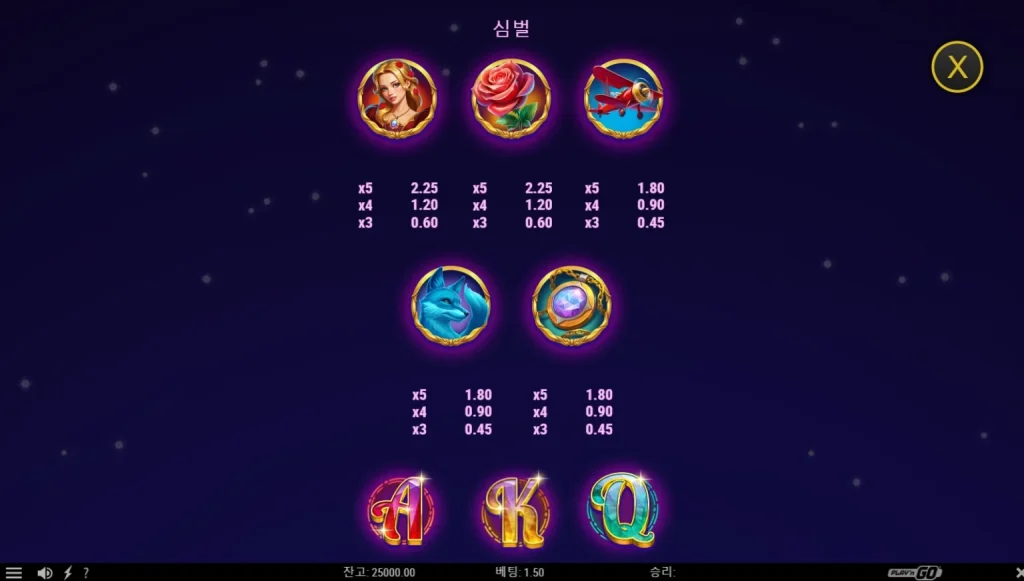
Confirm that the local paytable describes:
- The 5×5 layout.
- The number of active win ways.
- The required number of matching symbols.
- The starting reel for qualifying combinations.
- How large symbols are counted.
A large symbol visually occupies four cells but may count as only one symbol per reel. Misreading this rule can make the grid appear more favorable than the paytable evaluation actually allows.
Treasure Turn Trigger
Verify that Treasure Turn begins after a qualifying win and continues only while new winning combinations form.
There is no timing decision that controls the rotation. Stopping the animation, changing spin speed, or pressing the spin button at a particular moment does not change a completed random outcome.
Large-Symbol Multipliers
Check how multipliers are created, transferred, and applied.
Important questions include:
- Does each crushed symbol add exactly +1?
- Can an existing multiplier be absorbed?
- Is the multiplier applied only when the large symbol participates in a win?
- Does the multiplier persist after the sequence ends?
- How are several multiplied symbols combined?
Rules shown inside the local game should take priority over summaries from external review pages.
Starfall Rules
Confirm when Starfall can occur and what each visual effect means. Meteors and stars may have different functions.
A dramatic animation may remove symbols or create Wilds without producing a win. The visual intensity of the event is not evidence of a specific payout value.
Free-Spin Trigger and Retriggers
Verify:
- The number of Scatters required.
- Whether Scatters can be collected across cascades.
- The initial number of free spins.
- The multiplier level applied to large symbols.
- How often the multiplier level increases.
- How extra spins are awarded.
- The maximum permitted number of spins.
Reviewed descriptions consistently identify eight starting spins, an x3 starting multiplier on large symbols, increases after every fourth Treasure Turn, and two additional spins per extra Scatter, subject to a 60-spin maximum.
Maximum Payout
The reviewed specification lists a maximum payout of 6,000 times the bet.
Check whether reaching the cap immediately ends the spin or feature. Some games terminate a round once the maximum is reached, while others display the cap through separate wording.
Bet Display
Confirm whether the control shows:
- Total bet per spin.
- Coin value.
- Bet level.
- Any feature-related cost.
- Currency conversion or denomination.
The numeric range reported by review sources should not be assumed to apply in South Korean won or to every platform configuration.
Quick Reference Table
| Element | Documented specification | What the player notices |
| Layout | 5×5 grid | A square play area rather than narrow reels |
| Win system | 3,125 ways | Matches are evaluated across adjacent reels |
| Main mechanic | Treasure Turn | The grid rotates after a win |
| Direction | 90 degrees counter-clockwise | Existing symbols change relative positions |
| Large symbols | 2×2 blocks | One icon occupies four visible cells |
| Multiplier method | Symbol crushing | Large symbols gain value by crushing smaller symbols |
| Random modifier | Starfall | Symbols may be destroyed or changed into Wilds |
| Free spins | Eight initially | The bonus starts with a fixed spin allocation |
| Free-spin large symbols | Begin at x3 | Oversized symbols enter with an enhanced multiplier |
| RTP | Multiple documented versions | The exact local disclosure must be checked |
| Volatility | Medium | Results can still arrive unevenly |
| Maximum payout | 6,000× bet | Payouts are capped at the documented limit |
Common Mistakes and Misconceptions
Assuming Every Version Has 96.20% RTP
The highest published RTP is not necessarily the RTP of the version displayed on a particular platform. Lower configurations have been documented.
The correct approach is to inspect the local help, rules, or information menu before interpreting the game mathematics.
Treating RTP as a Session Prediction
A 96.20% theoretical RTP does not mean that a player should receive 96.20 units back from every 100 units used in one session.
RTP is a long-run mathematical average across a very large number of rounds. Short sessions can finish substantially above or below it.
Assuming a Rotation Makes a Win More Likely
Treasure Turn changes the visible arrangement after an existing win. It does not mean every rotation will create another win.
The sequence stops as soon as the newly evaluated grid contains no qualifying combination.
Counting a 2×2 Symbol Four Times
A large symbol may occupy four visual cells while being treated as one symbol instance. Its size affects grid movement and crushing interactions, but it should not automatically be counted as four matching symbols.
Believing a Built Multiplier Must Pay
A large symbol can accumulate a multiplier and still fail to join a qualifying combination before the cascade ends.
Multiplier growth represents conditional payout potential. It is not a stored payment.
Expecting a Feature Because It Has Been Absent
A long period without free spins does not make the feature “due.” Each random game round is evaluated according to the programmed mathematics.
Past non-winning spins do not force the next spin to trigger Scatters, Starfall, or a long Treasure Turn chain.
Using a Timing System
Stopping reels, changing animation speed, switching devices, or pressing at a particular moment does not create a reliable advantage in a random slot game.
The visual presentation occurs after or alongside the result generation. It should not be confused with a skill-based timing window.
Treating Medium Volatility as Low Risk
Medium volatility is a broad description of result distribution. It does not establish a safe stake, predictable feature frequency, or guaranteed session duration.
The broader Play’n GO RTP and volatility explanations can help distinguish provider-supplied mathematical disclosures from impressions formed during a short session.
Simple Gameplay Examples
One-Rotation Sequence
Suppose a paid spin creates one qualifying combination.
The winning symbols disappear, the matrix turns, and new symbols enter. If the revised grid contains no win, the sequence ends after that single rotation.
The original win is still paid according to the paytable. The absence of a second cascade does not cancel it.
Large-Symbol Multiplier Example
Suppose a 2×2 symbol moves into an open area and crushes two ordinary symbols.
If the local rules add +1 for each crushed symbol, the large symbol gains two multiplier steps. That multiplier affects the payout only if the large symbol later participates in a qualifying combination.
The example explains the feature logic. It does not estimate how often such an event occurs.
RTP Comparison Example
Over a theoretical turnover of 100,000 units:
- A 96.20% model corresponds to a theoretical return of 96,200 units.
- A 94.20% model corresponds to a theoretical return of 94,200 units.
- An 84.20% model corresponds to a theoretical return of 84,200 units.
These figures describe long-run mathematical models, not expected results for one person or one session. Actual short-term results can differ sharply because of variance.
Responsible Gambling Note
로지 오빗 트레져 턴 is a chance-based game. Treasure Turn chains, growing multipliers, Starfall events, and free-spin retriggers can extend a round, but none of them creates a reliable method for recovering losses or predicting the next result.
Set a fixed spending limit and a fixed time limit before starting. Base the stake on the possibility of losing the full session allocation, not on the maximum payout shown in the rules.
Do not increase the bet because several spins have ended without a feature. Do not chase a multiplier that disappeared when a cascade ended. Stop when the predetermined limit is reached, even if a bonus appears to be “close.”
South Korean readers should also verify local legal restrictions and age requirements. Do not use technical workarounds to evade access controls, identity verification, geoblocks, or payment restrictions.
FAQ
What is the RTP of 로지 오빗 트레져 턴?
Available sources list 96.20% as the highest documented RTP configuration. They also identify lower versions of 94.20%, 91.20%, 87.20%, and 84.20%. Check the RTP shown in the local game rules before interpreting a specific version.
How does Treasure Turn work?
After a qualifying win, the winning symbols disappear and the complete grid rotates 90 degrees counter-clockwise. Remaining symbols shift into open positions, new symbols enter, and the grid is evaluated again. The sequence continues while new wins form. Once an evaluation produces no new win, the Treasure Turn sequence ends.
Is 로지 오빗 트레져 턴 different on PC and Mobile?
The grid size, control placement, menu access, and animation scaling can look different across PC and Mobile screens. PC may provide more room for following large-symbol multipliers, while Mobile may condense information into smaller menus.
Resources
- Play’n GO, Play’n GO Introduces Innovative New Mechanic in Rosy Orbit Treasure Turn
- AboutSlots, Rosy Orbit Treasure Turn Slot Review
- Bonkku, Rosy Orbit Treasure Turn Demo & Slot Review
- SlotsMate, Rosy Orbit Treasure Turn Slot Review, Bonuses & Free Play
- Lucky Mobile Slots, Rosy Orbit Treasure Turn Slot Review