Quick Answer
파워 파우 is a Push Gaming slot built around a nudging Colossal symbol that stays on the grid for multiple spins, revealing prizes step by step while other feature symbols can expand it and lift the total multiplier. The moment-to-moment feel is less about a single spin “hitting,” and more about watching the board state develop while the Colossal moves down the grid. Push Gaming notes that RTP can vary by casino configuration, so the most practical first step is checking the RTP display inside the game you are actually running.
Key Takeaways of 파워 파우
- The core tension comes from a Colossal symbol that triggers respins while it remains on the grid, nudging down one row per spin.
- Instant prize values are revealed from the Colossal, with listed values ranging from x10 up to x1000, and the minimum prize can scale with the Colossal size.
- Expander and multiplier increaser symbols can remain on the grid after activation, so “what is left on the screen” matters for how the next spins feel.
- RTP messages are easy to misread as a short-term promise, research shows many players misunderstand what RTP means in practice.
- The same habits used on Push Gaming provider overview help here, verify the in-game RTP, read feature labels, and treat volatility as a session feel signal, not a forecast.

What 파워 파우 Means / How It Works
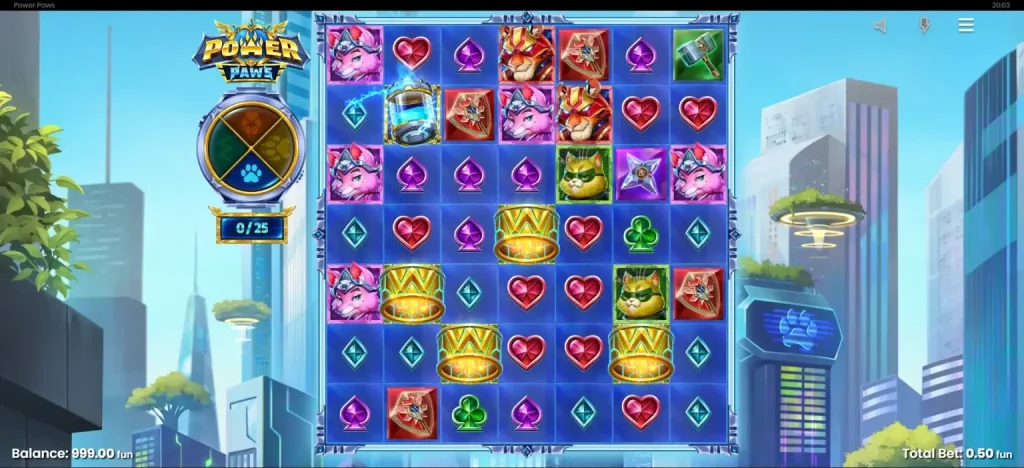
Think of 파워 파우 as a stateful slot. Instead of each spin feeling fully independent in presentation, the game often asks you to follow a mini-sequence: a Colossal symbol appears at the top, respins continue while it stays on the grid, and it nudges downward one row per spin. Each step reveals a new “prize” layer, which changes the emotional pacing from sudden surprise to gradual disclosure.
Three features shape that “sequence” feeling:
- Instant Prizes on the Colossal
The Colossal can reveal instant prize symbols, with listed values including x10, x25, x50, x100, x250, x500, and x1000. A key detail is that the minimum prize value can scale with the Colossal size, so a larger Colossal is not just a bigger graphic, it can shift what “a low reveal” means. - Expander Symbol
The expander increases the Colossal size by +1×1 and remains on the grid after activation. In play terms, it makes the session feel like it is “building a platform,” because the board can carry forward a more influential Colossal shape. - Multiplier Increaser Symbol
The multiplier starts at x1 and increases as the Colossal nudges, and multiplier increaser symbols raise the total win multiplier by their value, also remaining on the grid after activation. When this stacks up, even ordinary-looking wins can suddenly feel heavier, not because anything is guaranteed, but because the same hit now lands under a larger multiplier state.
If you want the “house style” context for how Push Gaming tends to label and present these mechanics, Push Gaming game UI and rules style is the right reference point.
What to Check in the Game Rules Screen 파워 파우 (Practical, Non-Promissory)
For South Korea readers, the most useful approach is still universal: verify what the game itself discloses on your device and session, because settings can differ by operator and jurisdiction.
- RTP display and any notes about variation
Push Gaming explicitly flags that RTP can vary by casino, and indicates it can be checked via the loading screen and the user panel. That is your most reliable source for the RTP of the version you are playing.
Also, remember that RTP is a long-run statistical design measure, not a promise about today’s session, and player testing research shows RTP wording is commonly misunderstood. - Feature labels that change “session rhythm”
Look for wording like “respins occur while the symbol is on the grid,” “nudges down one row per spin,” and “remains on the grid after activation.” Those phrases explain why the game can feel like it moves in chapters rather than single spins. - Instant prize value list and scaling detail
The listed instant prize values and the note about minimum prize scaling are not just trivia. They tell you what range of reveals is possible and how the “low end” might shift when the Colossal grows. - Any published volatility clue
Volatility labels are not always standardized across the industry, but when a provider gives a volatility band, it is best read as a “how swingy can this session feel” indicator. Combine it with bankroll limits rather than trying to time outcomes.
For broader trust context, some regulators require clear rules and game descriptions for remote games, and independently tested compliance against technical standards before release in that market. This is a useful mental model for what “good disclosure” looks like, even if you are playing elsewhere.

Quick Reference Table
| What to verify | Where you usually find it | What it changes in play |
|---|---|---|
| RTP for your exact version | Loading screen, user panel | Helps set realistic expectations (long-run only) |
| Colossal respin, nudge flow | Rules, feature help | Explains why action comes in sequences |
| Instant prize range and scaling | Rules, feature help | Sets the “reveal ladder” you are watching |
| Expander, multiplier symbols persist | Rules, feature help | Makes board state matter for feel and pacing |
| Volatility hints if disclosed | Rules, info panel | Signals swing potential, not timing or certainty |
Common Mistakes / Misconceptions
- Treating RTP like a short-term payout guarantee
RTP is often read as “what I should get back soon,” but player research shows RTP messages can be interpreted incorrectly, including overly optimistic assumptions about personal outcomes. - Assuming the game is “due” because the Colossal is building
Persistent symbols and nudging sequences can feel like a countdown, but they are presentation and state mechanics, not a promise that a particular reveal is coming next. The safest interpretation is: the game is showing you what can influence wins, not guaranteeing when it will. - Chasing the “next reveal” by extending sessions
A reveal-based slot can tempt longer play because the screen looks unfinished. This is exactly where pre-set session time and loss limits matter most.
Examples (Only if directly clarifying)
- Two sessions can look completely different even at the same RTP. In one, the Colossal sequence appears early and resolves quickly with modest reveals. In another, you may see longer quiet stretches, then a single sequence where multipliers and reveals align and the result looks much bigger. That difference is variance, not a pattern you can reliably read or repeat.
Responsible Gambling Note
If a slot’s entertainment value comes from sequences and “board state,” it can be easy to keep playing just to see how the current setup resolves. Setting a clear time limit and a loss limit before you start is the simplest way to avoid session creep. For support in South Korea, the Korea Problem Gambling Agency (KCGP) provides counseling and operates a national gambling helpline (1336).
For foundational terminology, Casino Playing Basics can help you separate RTP, volatility, and bankroll limits into practical, non-promissory concepts.
FAQ
Is 파워 파우 RTP fixed?
Not necessarily. Push Gaming states RTP can vary by casino configuration and says it can be checked in the loading screen and user panel. Treat the in-game RTP display as the most relevant value for your version.
What does “nudging Colossal with respins” feel like during play?
It often feels like the game switches into a mini-round where attention shifts from “spin outcome” to “what will be revealed next as the Colossal moves down.” Because prizes are revealed step by step, the pacing can feel more like unfolding information than a single sudden hit.
Do persistent expanders and multipliers mean the game is getting more likely to pay?
They mean the board can hold onto features that influence how wins are calculated or displayed, but they do not guarantee a near-term outcome. Use the feature wording as a description of mechanics, not as a predictive signal, and cross-check how Push Gaming explains its mechanics on Push Gaming slots and feature labels.
Resources
- Push Gaming, “Power Paws”
- GambleAware (NatCen), “Understanding of Return to Player messages”
- UK Gambling Commission, “Return to Player Games”
- Korea Problem Gambling Agency (KCGP), “Overview”
- UK Gambling Commission, “Remote gambling and software technical standards (RTS)”