Quick Answer
3 핫 칠리 is a Booongo (BNG) slot built around a Hold and Win bonus that can change feel depending on which chili meter fills, so the session rhythm tends to swing between steady base spins and sudden, feature-led respin bursts. The exact RTP and any bonus purchase option can vary by version and jurisdiction, so treat the rules screen as the source of truth for what you are playing.
Key Takeaways for 3 핫 칠리
- The “chili meters” are the pacing engine, they decide which bonus flavor you are most likely to see next.
- Hold and Win bonuses are about space management and tension, each respin is a small reset moment that can extend the round.
- RTP is a long-run average, it does not describe what a short session “should” return.
- In South Korea context, legality and availability depend on where you are and what is licensed there, avoid assuming a game version is the same everywhere.
- Set a session stop point before you start, Hold and Win loops can feel “one trigger away” even when nothing is due.

What 3 핫 칠리 Means / How It Works
At its core, 3 핫 칠리 plays like a classic five-reel slot most of the time, then flips into a concentrated respin mode when the feature condition is met. In the base game, your attention is usually pulled to two things: how quickly the meters are building, and whether the reels are showing you the kinds of bonus symbols that signal the game is “warming up.”
The distinctive part is that the bonus is not just “trigger and watch,” it is “trigger and then live inside the respins.” A Hold and Win round typically feels like a contained mini-session: you start with a small number of respins, each new bonus symbol can refresh the counter, and the screen tension comes from watching remaining empty spaces and the respin counter at the same time.
If you want the broader context of how Booongo structures this kind of feature pacing across its catalog, Booongo game style and feature pacing helps frame what “meter-led Hold and Win” usually means in practice.
What to Check in the Game Rules Screen
This is the practical checklist that keeps your expectations aligned with the exact version you are playing.
- RTP disclosure wording (and the actual percentage)
Look for an explicit RTP line in the rules or info menu, and note whether it lists multiple RTP settings. RTP is an average over a very large number of plays, so a short session can land well above or below it. - Volatility or risk hints (if stated)
Some games disclose volatility directly, others do not. If it is stated, treat it as a description of payout shape, not a forecast. If it is not stated, you infer “feel” from feature cadence: long quiet stretches with occasional heavy spikes usually play higher-risk than frequent small hits. (Do not assume which one applies until you have checked the rules and observed a real stretch of spins.) - How the chili meters fill
Confirm what counts toward each meter (specific symbols, any reel restrictions, or “only on paid spins” limitations). This matters because meter speed is your session tempo, faster meters mean more frequent bonus transitions, slower meters mean longer base-game stretches. - Hold and Win trigger condition
The rules should describe what has to happen before the respin feature starts. This is the difference between “I am building toward something” and “I am still just spinning,” which is key to managing expectations. - Respin counter rules and reset behavior
Verify the starting respin count, and exactly what resets it (usually landing a new bonus symbol). This changes how the bonus feels: reset-on-hit creates that rolling, suspenseful loop where every new symbol buys time. - Any in-bonus modifiers (multipliers, extra respins, extra reels)
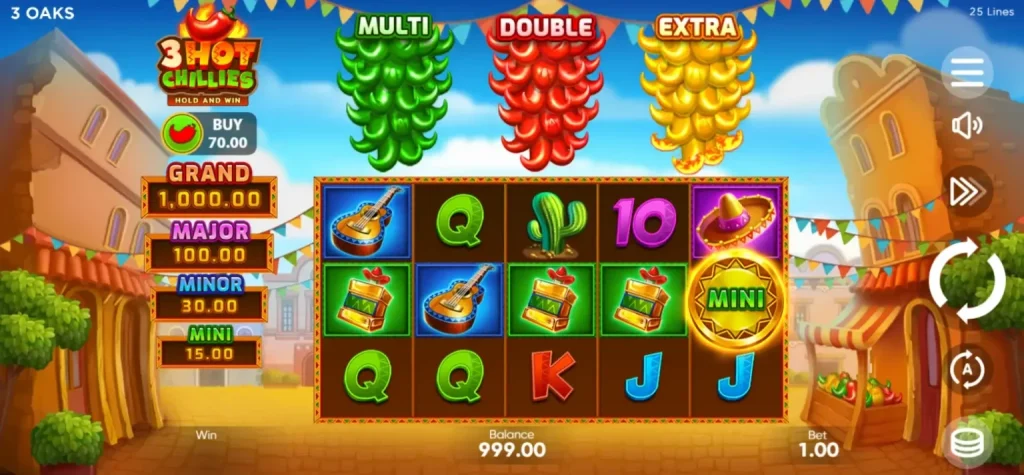
The provider descriptions for this title mention bonus variants that can add multipliers, extra respins, or expand play area. Confirm which ones are in your build, and whether they can stack in a single bonus. - Jackpot labeling and whether it is fixed
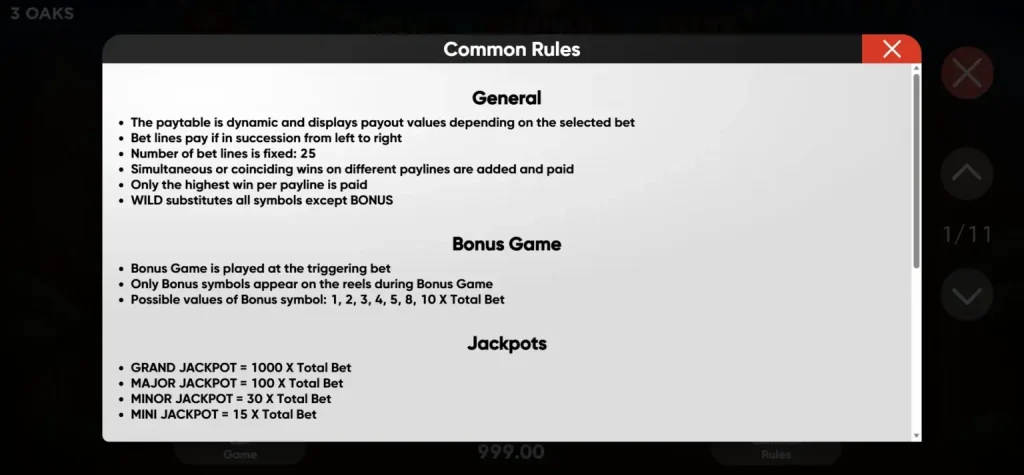
If the game shows MINI, MINOR, MAJOR, GRAND style labels, confirm in the rules whether they are fixed prizes, bet multipliers, or something else, and whether they are part of the game math or operator-side. Do not assume every label is a progressive jackpot. - Bonus purchase option (if present)
Some versions mention a buy bonus button. If you see it, check the rules for cost and conditions, and note it may be disabled depending on jurisdiction and operator settings. For the South Korea context, availability can be constrained by local rules and licensing.
A quick reference point for where these disclosures usually live in Booongo interfaces is Booongo rules screens and RTP disclosures.
Quick Reference Table
| Item to verify | Where it changes the feel of play |
|---|---|
| RTP setting(s) listed | Long-run cost profile, not short-run outcomes |
| Meter fill rules | How quickly you move from base spins into feature tension |
| Respin reset condition | Whether the bonus feels “alive” and extendable |
| Bonus modifiers included | Whether the feature is mostly coin collection, or includes big swing moments |
| Jackpot labels definition | Prevents misreading labels as guaranteed or progressive prizes |
Common Mistakes / Misconceptions
- “RTP means I should get about 95% back today.”
RTP is an average measured across a very large number of plays, your session can easily deviate in either direction. - “The meter is almost full, so a bonus is due.”
Meters can create a strong psychological “next spin” pull. They are a progress display, not a promise of timing or outcome. - “A cold stretch means the bonus will pay bigger when it arrives.”
That is the gambler’s fallacy. Randomized outcomes do not “balance” on a schedule. - “Bonus buy makes results more predictable.”
Buying access changes when you reach a feature, not the underlying randomness inside it, and it can compress risk into a shorter time window.
Examples
- RTP as a long-run concept: If a slot lists an RTP of 95.59%, that describes an average return over an extremely large number of spins, not a target for a single night or a single bonus round.
- Volatility as session shape: Two sessions can have the same RTP in theory, but one feels “choppy” with many small hits, while another feels “quiet then explosive” with fewer, larger swings. That difference is volatility, and it is why short sessions can feel very uneven even when the RTP number looks similar.
Responsible Gambling Note
Feature-driven slots can encourage “one more spin” thinking because progress meters and respin counters make outcomes feel close. In South Korea, if gambling is causing stress, loss-chasing, or money problems, consider setting a firm time and spend limit before play, and use local support services such as the Korea Problem Gambling Agency (helpline 1336).
FAQ
Is 3 핫 칠리 the same game everywhere in South Korea?
Versions and settings can differ by operator, platform, and jurisdiction, including RTP configurations and whether certain options are enabled. The rules screen for the exact build you are playing is the reliable reference.
What does “Hold and Win” usually feel like during play?
It typically feels like a contained, suspense-heavy loop: a small set of respins, a reset when a new bonus symbol lands, and a rising focus on empty spaces and remaining spins. The official game descriptions for this title emphasize bonus variants that can add extra respins, multipliers, or expanded reel space, which changes how quickly tension builds.
Where do I find the RTP and feature rules quickly?
Most slots place RTP and feature definitions in the in-game info menu, paytable, or rules panel. Booongo slot RTP and feature terminology is a helpful map of the labels you are likely to see. RTP remains a long-run average, not a short-session guarantee.
Resources
- BNG Games, “3 Hot Chillies”
- 3 Oaks Gaming, “3 Hot Chillies”
- UK Gambling Commission, “Return to player: how much gaming machines payout”
- Korea Problem Gambling Agency, “Main”
- National Gambling Control Commission (Korea), “National Master Plan For Responsible Gambling”