Quick Answer
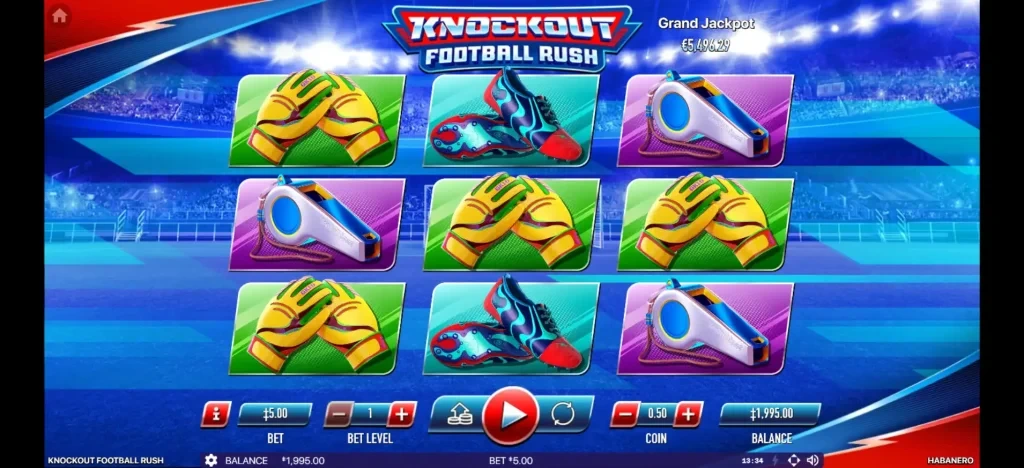
넉아웃 풋볼 러쉬 is a compact 3×3 slot where the main rhythm comes from a random “Penalty Kick” moment that drops extra wilds onto the bottom row, then those wilds stay on the grid and walk upward each new game. When enough wilds are visible, they multiply any win, so the session feel often swings between quiet stretches and sudden “everything pays bigger” bursts. This mechanic is described directly in the game help document.
Key Takeaways for 넉아웃 풋볼 러쉬
- The Penalty Kick feature is random, it can add 1 to 3 wilds to row 3 without warning.
- Wilds stick, then move up one row at the start of every new game, while symbols on row 1 are removed each new game.
- Multipliers depend on how many wilds are on screen, with higher tiers at 3–5, 6–8, and 9 wilds.
- RTP is a long-run average, it does not describe what a single session “should” return.
- For South Korea readers, it helps to treat pace controls (like quick spin) as a spending-speed factor, not a “better odds” switch.

Definition
넉아웃 풋볼 러쉬 is a feature-led slot built around sticky walking wilds and tiered win multipliers. Your main “decision” is not complex strategy, it is managing expectations around volatility and speed, because the feature timing is random and the multipliers only matter when wins actually land.
What 넉아웃 풋볼 러쉬 Means / How It Works
The game’s feel is simple on the surface, but busy underneath.
A typical stretch looks like this:
- You spin through a few standard outcomes, mostly small hits or blanks.
- A Penalty Kick triggers at random and drops 1 to 3 wilds onto the bottom row (row 3).
- Those wilds do not vanish immediately. They remain on the reels, then “walk” up one row at the start of each new game.
- At the same moment, the top row (row 1) is cleared at the start of each new game, so the grid constantly refreshes around the wilds instead of simply accumulating forever.
That push-pull is the heart of the pacing. You can feel the game alternating between rebuilding the grid and briefly stabilizing it, which makes wins feel streaky when the wild count crosses a multiplier threshold.
This is also why reading a provider overview can help before you even look at numbers, Habanero game style overview gives useful context for how Habanero tends to label features and present rules in-menu.
What to Check in the Game Rules Screen (Practical, Non-Promissory)
These are the checks that change what the game feels like, without pretending to predict outcomes.
- Confirm the feature is random
The help file states the Penalty Kick feature triggers at random. If you see wording like that, treat “it’s due” thinking as noise, because prior spins do not create a schedule. - Verify wild behavior and the row reset
Make sure the rules screen matches the two-part loop: wilds stick and move up, row 1 clears each new game. This tells you why a “good-looking” screen can still cool off quickly, the board is designed to churn. - Check multiplier tiers and what they apply to
The rules list tiers where 3–5 wilds multiply all wins by x2, 6–8 by x4, and 9 by x60. The key gameplay takeaway is that the multiplier is conditional on two things at once: enough wilds visible, and a win landing.
If you want a broader framework for interpreting this kind of swing, Habanero RTP and volatility basics can help you separate “feature excitement” from risk reality. - Look for how wins are counted on the grid
The help file describes horizontal and vertical pays, with intersecting or overlapping wins adding together. That changes the on-screen feel, one spin can look like multiple mini-wins stacking rather than a single line hit. - Find any RTP disclosure text
If the game (or the platform menu) shows RTP, treat it as a long-run average and not a session promise. Regulators commonly explain RTP this way, so it is normal for short sessions to look nothing like the headline percentage.
Quick reference table
| What you verify | What you will notice while playing | Why it matters for session feel |
|---|---|---|
| Random Penalty Kick | “Nothing happens” until it suddenly does | Reinforces volatility and patience pressure |
| Sticky walking wilds | Wilds persist, then migrate upward | Creates streaky windows where the grid behaves differently |
| Row 1 clears each new game | The board never fully “locks in” | Prevents pure accumulation, cools hot-looking screens |
| Multiplier thresholds | A win can feel dramatically bigger | Only pays when a win lands, no win means no multiplier value |
| RTP wording | Long-run average, not session result | Helps avoid chasing based on a number |
Common Mistakes / Misconceptions
- Mistaking RTP for “what should happen tonight”
RTP is typically presented as an average achieved over many plays, not what you should expect per session. - Thinking wild buildup guarantees a payoff
The rules say multipliers apply when enough wilds are on screen, but they still multiply wins, not hope. It is completely possible to see more wilds without seeing a meaningful connection. - Believing speed settings change odds
Quick spin and autoplay change tempo and spending pace, not the underlying randomness. If you use faster play on mobile, it mainly compresses time and can make swings feel sharper.
Examples (clarifying only)
- Why two sessions can feel opposite in the same game
Session A: Penalty Kick arrives early, wild count reaches a multiplier tier, and a few stacked horizontal or vertical wins land close together.
Session B: The same random feature appears later, or wilds walk off useful rows before wins connect, so the screen looks active without delivering the same payoff pattern.
Both can happen under a long-run RTP model, which is exactly why RTP does not describe short-run results.
Responsible Gambling Note
Slots with random feature timing and multiplier tiers can create strong “just one more spin” pressure, especially when wilds are visible but not yet converting into wins. If you notice chasing behavior, stress, or difficulty stopping, consider using support services that provide practical guidance and emotional help.
A short, practical reminder for South Korea readers is to set a time limit and a spend limit before you start, then treat quick spin as a pace accelerator that can burn through that limit faster.
FAQ
Is the Penalty Kick feature something you can trigger on purpose?
The game help describes it as random, so it is not a “complete a pattern” type of trigger.
Do the multipliers apply only to specific lines?
The rules state the multiplier tiers are based on wild count on screen and they multiply all wins, which means any qualifying win gets multiplied while the condition is met.
Why do wins sometimes stack in a single spin?
Because the rules allow horizontal and vertical pays, and wins can intersect or overlap, multiple combinations can add together in one outcome. For more on how providers usually explain these rule screens, Habanero rules screen walkthrough is a useful reference point.
Resources
- YesPlay.bet, KNOCKOUT FOOTBALL RUSH HELP (PDF)
- UK Gambling Commission, Return to player: how much gaming machines payout
- Gambling Therapy (Gordon Moody), Providing online help for people experiencing gambling harm
- National Council on Problem Gambling, Problem Gambling Treatment Options
- eCOGRA, Ensuring Fair Play with RNG Testing and eCOGRA Certification