Quick Answer
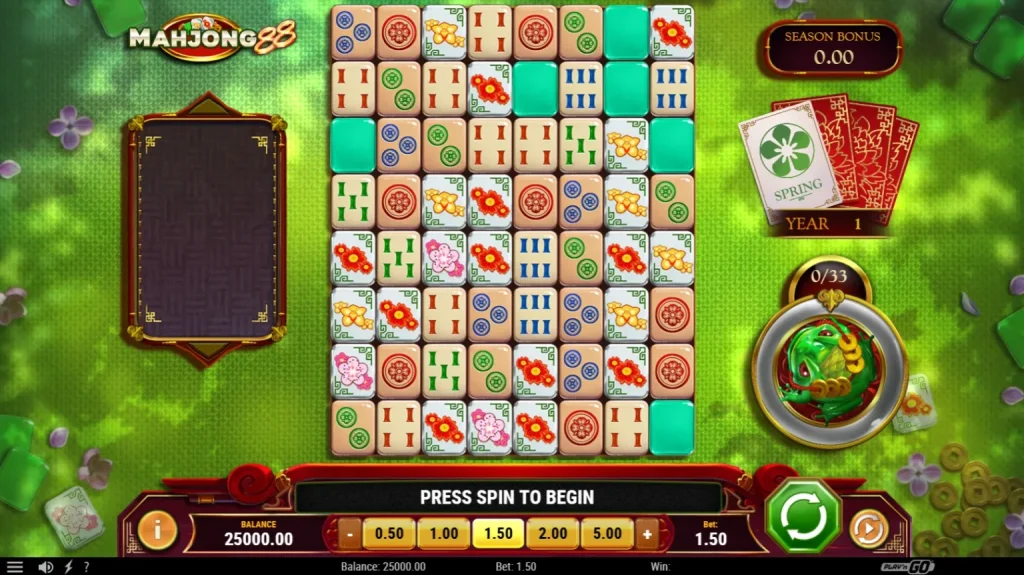
마작 88 is a PLAY’n GO grid slot built around an 8×8 board rather than conventional paylines. A standard win starts when at least four matching symbols connect horizontally or vertically. Winning symbols are removed, replacement symbols fill the gaps, and the process can continue while new winning clusters keep forming. PLAY’n GO describes Mahjong 88 as its first 8×8 grid slot and lists its release date as May 2, 2019.
The gameplay is shaped by four seasonal Wild types, Concealed Tiles, the Fortune Frog meter, and a Super Charge mechanic. This gives a single game round a changing rhythm, because one initial cluster can lead into symbol removal, replacements, meter progress, transformations, Wild effects, or additional clusters before the board settles.
For players in South Korea, this guide should be treated as educational game information rather than an indication that real-money online casino play is legally available. South Korean gambling and gaming laws tightly regulate gambling-related activities, and the availability of a website or game does not by itself establish that real-money use is lawful.
Key Takeaways
- 마작 88 uses an 8×8 grid with cluster-based wins, not a conventional left-to-right payline structure.
- A standard winning cluster requires four or more matching symbols connected horizontally or vertically.
- Winning symbols are removed and replacement symbols enter the empty spaces, so one paid game round can contain several consecutive board changes.
- Spring, Summer, Autumn, and Winter each use a different Wild behavior, meaning the current season changes how Wilds interact with the grid.
- The Fortune Frog meter responds to winning symbols, while an overcharged meter can trigger Super Charge under the documented rule set.
- RTP and volatility figures differ across current published sources, so the rules or information panel in the specific version being viewed should take priority over a third-party review.
What It Means / How It Works
마작 88 does not play like a traditional slot where attention is concentrated on horizontal paylines or left-to-right symbol combinations. The entire 8×8 board matters.
A winning group forms when at least four identical symbols touch horizontally or vertically. Diagonal contact alone does not create the documented standard cluster. PLAY’n GO describes the game as using clusters instead of paylines.
Once a cluster wins, those symbols are removed. Replacement symbols then fill the open spaces, creating the possibility that the changed board will immediately form another cluster. This makes the flow more sequence-driven than a simple spin, result, reset pattern.
Players familiar with PLAY’n GO game mechanics will recognize the importance of reading the entire feature cycle rather than judging the game only by what appears in the first grid.
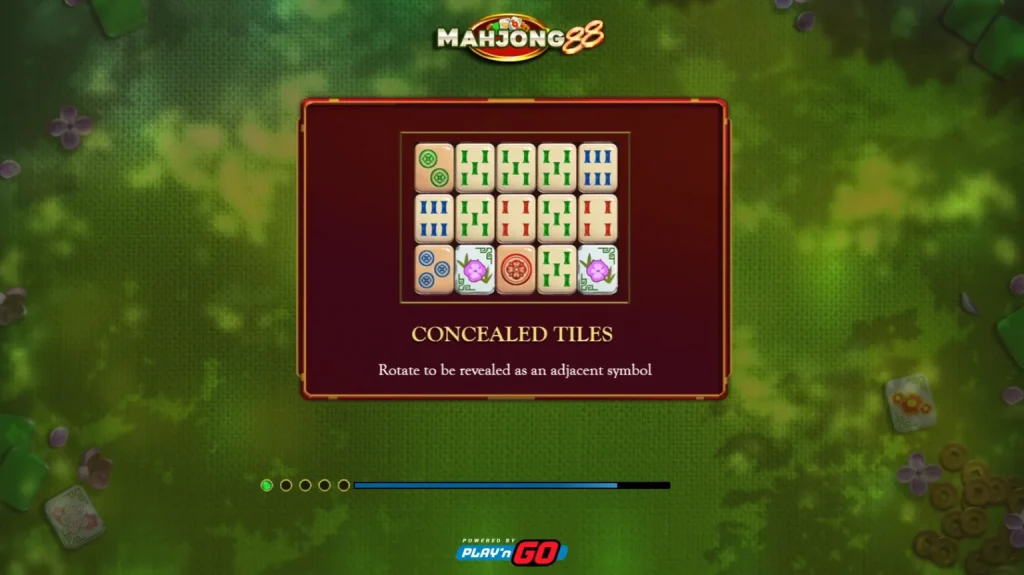
Concealed Tiles
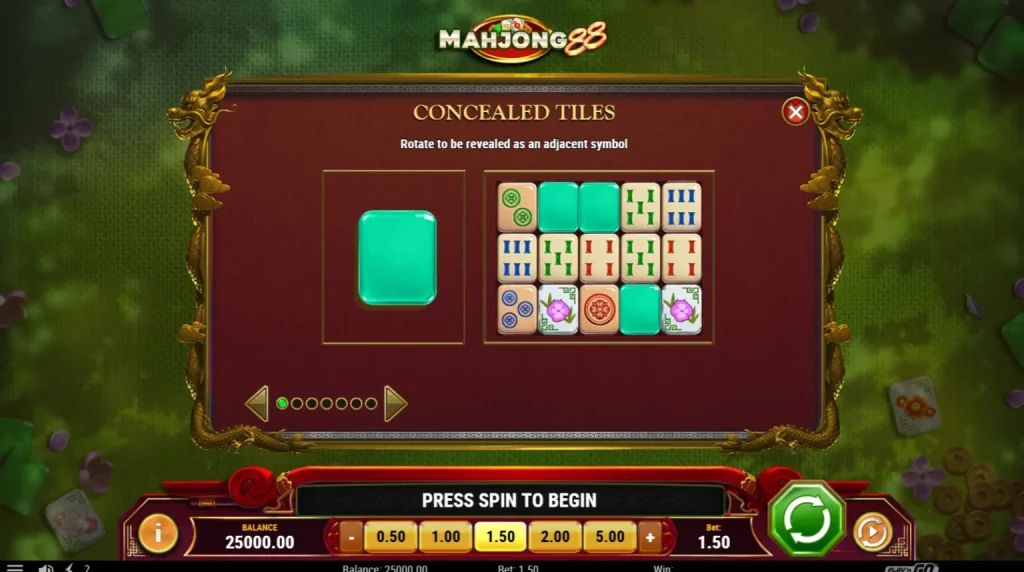
Blank-looking Concealed Tiles can appear on the grid. The documented rules state that these tiles rotate and reveal a secret symbol based on an adjacent symbol.
From a gameplay perspective, this means part of the grid can change after the initial layout becomes visible. A board that looks disconnected at first can therefore develop differently as Concealed Tiles reveal their values.
Four Seasons and Four Wild Behaviors
Mahjong 88 cycles through Spring, Summer, Autumn, and Winter. Each season is associated with a different Wild mechanic. PLAY’n GO’s official description identifies the following behavior:
- Spring Wild: Wild symbols can be placed randomly on the grid.
- Summer Wild: Wilds are added while adjacent symbols are destroyed.
- Autumn Wild: Wilds move through the grid while some symbols are destroyed.
- Winter Wild: Wilds can remain in position when they form part of a winning cluster.
These effects produce noticeably different board behavior. Spring concentrates more on additional Wild positions, while Summer and Autumn can alter surrounding symbols. Winter can allow a Wild to survive a winning removal and remain relevant to the next board state.
The seasonal structure is one reason PLAY’n GO grid slots provides useful context when comparing Mahjong 88 with other games that use board-clearing or grid-based mechanics.
Fortune Frog
Winning symbols also contribute to the Fortune Frog meter.
A currently published rules implementation states that the meter becomes fully charged at 33 winning symbols. Once the active chain has finished, one of four effects can occur:
- Croak: a selected symbol can pay in scattered positions.
- Spawn: one symbol type can transform into another.
- Tongue: symbols between two selected edges can be transformed.
- Hop: a selected symbol can transform while adjacent symbols are removed.
These are board modifiers rather than a conventional free-spins round. They can change symbol distribution after the normal cluster sequence has developed.
Super Charge
The same rules source states that Super Charge is triggered when the Fortune Frog meter is overcharged with at least 88 winning symbols in the game round. Under that implementation, wins achieved during that game round are multiplied by five. Fortune Frog and Super Charge are each limited to one trigger per game round.
This is an unusually specific threshold, so it is worth verifying in the actual rules screen rather than assuming every distributed version uses identical parameters.
What to Check in the Game Rules Screen
RTP
A commonly published RTP figure for Mahjong 88 is 96.62%, including several long-running reviews.
However, current published implementations are not uniform. One available game-rules page lists 94.63%, while other current casino and catalog pages show still different figures.
That makes the specific game’s information panel more important than a generic review.
When checking PLAY’n GO RTP and game information, remember that RTP represents a long-run mathematical return under the configured game model. It does not predict what will happen in one spin, one chain reaction, or one playing session.
Cluster Requirements
Confirm that the version identifies wins using clusters of at least four matching symbols connected horizontally or vertically. This is the core mechanic documented by PLAY’n GO.
Understanding this prevents a common visual mistake, which is interpreting diagonal tiles or line-like patterns as winning combinations when they do not satisfy the cluster definition.
Seasonal Wild Rules
Check how the rules describe Spring, Summer, Autumn, and Winter.
Seasonal Wilds do more than substitute for normal symbols. Their behavior can change the surrounding grid, so knowing the active season explains why symbols disappear, remain in place, or become Wild.
Fortune Frog Thresholds
Look for the meter requirements and feature descriptions in the version being viewed.
Published game rules currently describe 33 winning symbols for Fortune Frog and 88 or more for Super Charge, but distribution settings and documentation can change.
Maximum Win and Other Caps
If the rules display a maximum payout multiplier, maximum win, bet limit, or feature cap, treat that figure as part of the game’s mathematical rules rather than a likely outcome.
Third-party sources commonly list a maximum potential around 5,000 times stake for Mahjong 88, but the official public game page currently focuses on mechanics rather than publishing that figure.
Volatility or Variance
Do not assume that one volatility label is universally authoritative.
Current third-party sources conflict. Some classify Mahjong 88 as high volatility, while another current listing describes it as medium, and one rules implementation labels its variance as low.
If the exact version does not disclose volatility clearly, it is safer to describe the observable gameplay mechanics than to assign a definite risk label.
Quick Reference
| Game element | What to verify | What it changes during play |
|---|---|---|
| Grid | 8×8 layout | More of the board is relevant to each result |
| Standard win | 4+ matching horizontally or vertically connected symbols | Determines whether a visible group qualifies |
| Winning-symbol removal | Symbols removed after a win | Can create consecutive cluster sequences |
| Concealed Tiles | Adjacent-symbol reveal behavior | Can alter an apparently incomplete cluster |
| Seasonal Wilds | Spring, Summer, Autumn, Winter rules | Changes how Wilds enter or affect the board |
| Fortune Frog | Meter and trigger threshold | Adds transformations or board modifiers |
| RTP | Exact percentage in the active version | Describes long-run theoretical return, not session results |
Common Mistakes / Misconceptions
Treating Mahjong 88 like traditional mahjong
Despite the theme and tile imagery, 마작 88 is a slot game of chance. It does not recreate the strategic decision-making structure of the traditional tile game.
The player’s main role is not selecting discards, building hands, or responding strategically to opponents. The slot determines symbols and feature outcomes according to its programmed game rules.
Looking for paylines
Mahjong 88’s standard wins are cluster-based. Four or more identical symbols need to connect horizontally or vertically. PLAY’n GO specifically describes clusters rather than conventional paylines.
Assuming every adjacent symbol counts
Diagonal symbols may visually appear close together, but the documented cluster rule uses horizontal and vertical adjacency.
Believing 96.62% RTP means receiving 96.62% back in a session
It does not.
Even where a 96.62% configuration is used, RTP is a long-run statistical property calculated over a very large volume of play. Individual sessions can finish far above or below that theoretical percentage.
Assuming recent losses make a win more likely
A sequence of losing rounds does not create a debt that the next spin must repay.
The gambler’s fallacy is the mistaken belief that previous random outcomes force later independent outcomes to compensate. Long losing sequences and short bursts of clustered wins can both occur without either pattern predicting what comes next.
Treating a feature meter as a guarantee of profit
The Fortune Frog meter changes when particular mechanics occur, but triggering a game feature does not mean the round will finish profitably.
Feature activation and overall financial outcome are separate questions.
Using a third-party volatility label as definitive
Current sources disagree about Mahjong 88’s volatility classification. The disagreement itself is a reason to verify the current rules rather than presenting one external rating as universally correct.
Example of a Cluster Sequence
Suppose four matching symbols appear in one horizontally or vertically connected group.
That cluster qualifies under the documented standard rule. Those symbols are removed, replacement symbols enter the empty spaces, and the new layout is evaluated again.
If the replacement symbols create another qualifying cluster, another win can occur in the same evolving sequence.
If they do not, the normal cluster sequence ends. Depending on the meter state, season, and applicable feature rules, another modifier may still affect the board.
This example explains why Mahjong 88 can feel less like watching separate reel spins and more like following a board through several stages of change. It does not mean that long sequences occur at predictable intervals.
South Korea Context
South Korea regulates gambling closely. The Gambling Industry Integrated Supervision Commission Act defines regulated gambling industries and addresses illegal gambling activity, while the Game Industry Promotion Act separately regulates gambling-type games and activities involving wagering or financial gain and loss.
Casino operations are also subject to specific statutory restrictions. Under the Tourism Promotion Act, ordinary licensed casino operators generally may not admit South Korean nationals, subject to the separate statutory framework governing the permitted domestic exception.
For that reason, the fact that Mahjong 88 can be viewed on an international provider website, demo page, or overseas casino site should not be interpreted as proof that real-money online play is lawful from South Korea.
This page covers game mechanics and mathematical concepts only. It does not provide methods for bypassing geographic restrictions, identity verification, age controls, payment restrictions, or local gambling law.
Responsible Gambling Note
마작 88 is a random gambling game when used for real-money play. Cluster sequences, Wild effects, Fortune Frog triggers, and previous wins or losses cannot reliably predict the next outcome.
If gambling is legal in the reader’s jurisdiction, practical risk controls include deciding the maximum amount and time to spend before play begins, avoiding attempts to recover previous losses, and treating money committed to gambling as money that may be lost completely.
Changing stake size does not change an unfavorable session into a predictable one, and a feature trigger should not be treated as a reason to extend a predetermined limit.
FAQ
What is the RTP of 마작 88?
A 96.62% RTP configuration is widely documented by historical and current review sources. However, current published versions also show different percentages, including 94.63%, so there is no reason to assume that every available implementation uses 96.62%. The current game’s rules or information panel should be checked directly.
Is 마작 88 a high-volatility slot?
Several sources classify Mahjong 88 as high volatility, but current listings are inconsistent. One source labels it medium volatility, while another published rules implementation labels variance as low. Because these descriptions conflict, the safest approach is to verify the specific version rather than presenting a universal volatility rating.
This distinction also matters when comparing the game with titles covered in the broader PLAY’n GO provider overview.
How does the Fortune Frog feature work?
Wins contribute symbols toward the Fortune Frog meter. A currently published rules implementation states that collecting 33 winning symbols fully charges the meter, after which one of four effects can modify the grid. The same rules describe Super Charge when the meter reaches at least 88 winning symbols, with a five-times multiplier applying to wins in that game round.
Resources
- PLAY’n GO: Mahjong 88 Slot Demo
- Online Slots Pilot: Mahjong 88 Slot Review, 96.62% RTP, Play N Go (2026)
- All Slots Online: Mahjong 88 (Play’n GO), Slot Review & Demo, September 2026
- SlotsLaunch: Mahjong 88 page, privacy error reported during access
- Slottomat: Mahjong 88 Slot Free, Play Free Demo, Play’n GO