Quick Answer
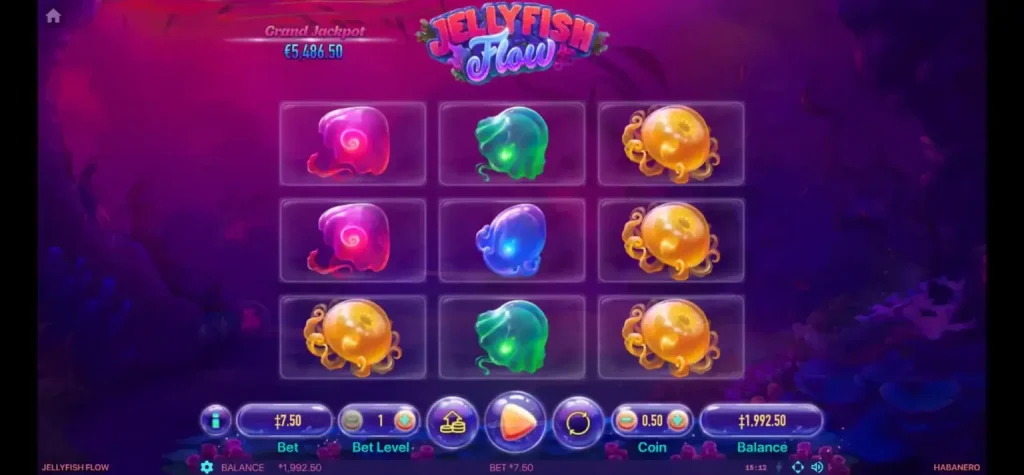
젤리피쉬 플로, officially titled Jellyfish Flow, is a Habanero slot built around an expanding game grid and moving Jellyfish Wild symbols. The game begins on a 3×3 grid with 27 ways to win and can expand to a 7×7 grid with as many as 823,543 ways.
The main gameplay feature is the Jellyfish Wild. Once one appears, it remains on the reels and moves upward by one position on subsequent spins. This creates a changing screen rather than a completely reset visual state after every spin.
Habanero currently classifies Jellyfish Flow as having Very High volatility and lists multiple available RTP configurations rather than one universal percentage. Players should therefore treat the RTP displayed inside the specific game version as the relevant figure.
Key Takeaways
- Jellyfish Flow starts with a 3×3 grid and 27 ways to win.
- The grid can expand as Jellyfish Wild symbols enter the game.
- Maximum expansion reaches 7×7 with up to 823,543 ways.
- Jellyfish Wilds remain active and move upward on following spins.
- Habanero lists several available RTP configurations, so one RTP should not be assumed for every version.
- The official volatility classification is Very High.
- Expanding reels and additional ways change the game’s structure, but they do not predict the outcome of the next spin.

What Is 젤리피쉬 플로?
젤리피쉬 플로 is a Habanero video slot in which the visible game area can change while a sequence of spins develops.
Instead of keeping the same reel dimensions throughout play, Jellyfish Flow begins with a compact 3×3 layout. Jellyfish Wild symbols can then trigger expansion, giving additional symbols space to appear and increasing the number of available ways to form winning combinations.
At maximum expansion, the game reaches a 7×7 layout with 823,543 possible ways.
This changing reel structure is useful for understanding Habanero slot gameplay mechanic, because the important part is not simply how many symbols are displayed, but how individual features change the pace and structure of a session.
How 젤리피쉬 플로 Works
Starting With 27 Ways
A normal game state begins on a 3×3 grid with 27 ways.
This makes the early screen relatively compact. The number of possible combinations increases when the game area expands, rather than starting at its maximum size on every spin.
The feature that drives this change is the Jellyfish Wild.
Jellyfish Wild Movement
A Jellyfish Wild does not behave like a Wild symbol that simply appears and disappears after one spin.
According to Habanero’s official game information, Jellyfish Wilds remain on the reels and move upward by one position during each following spin.
This gives the game a continuing visual state.
When one or more Jellyfish Wilds remain visible, the next spin is connected mechanically to what is already on the screen. New Jellyfish Wilds may also appear while existing ones continue moving.
The result is a gameplay rhythm based around watching Wild symbols enter, move through the grid, and eventually leave.
This type of persistent feature can also be understood within Habanero game feature design, where feature behavior matters more than simply memorizing the paytable.
Expanding to 823,543 Ways
The figure of 823,543 ways refers to the game’s maximum expanded configuration.
It does not mean that 823,543 ways are active from the first spin.
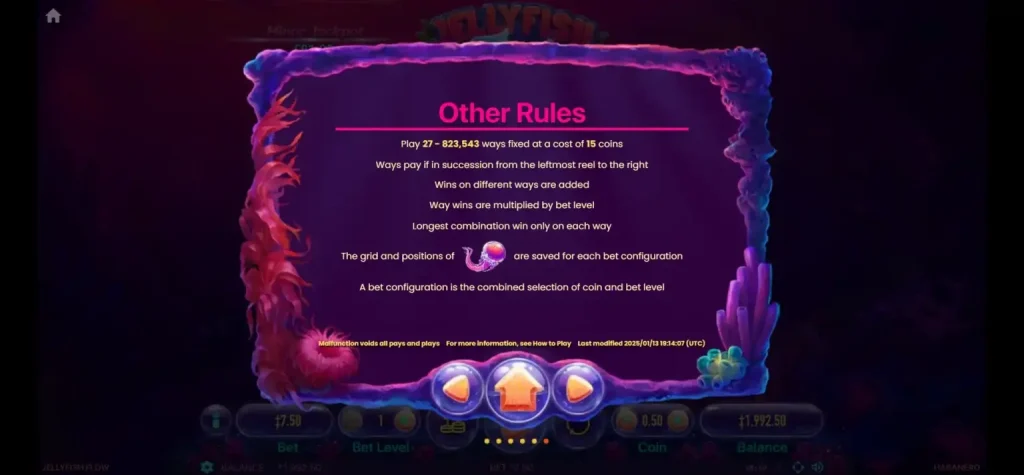
Jellyfish Flow begins at 27 ways. As the grid expands, the number of available ways increases until the maximum 7×7 layout is reached.
More ways increase the number of symbol arrangements that can potentially form qualifying combinations, but this should not be interpreted as a prediction that the next spin will produce a win.
What to Check in the Game Rules Screen
Check the Actual RTP
One of the most important details to verify is the RTP shown in the version being played.
Habanero currently lists several available RTP configurations for Jellyfish Flow, approximately:
- 86%
- 92%
- 94%
- 97%
- 98%
These figures should not be treated as if all versions use the same RTP.
A casino or distribution environment may use a particular configuration made available by the provider. The figure shown in the game’s own information or rules screen is therefore more relevant than a generic RTP quoted elsewhere.
This is an important part of Habanero RTP configuration and game information, especially for games that support more than one mathematical configuration.
RTP is also a long-run theoretical measurement. It does not indicate what an individual player should expect to receive during a short session.
Check the Volatility Rating
Habanero currently describes Jellyfish Flow as Very High volatility.
Volatility relates to how widely results can vary rather than whether a game is more likely to produce a winning spin.
A very high volatility classification can produce a session in which outcomes feel uneven, with longer periods of limited activity potentially separated by larger changes in results.
It does not guarantee larger payouts.
Check the Ultra Version or Label
Habanero also describes an Ultra form of Jellyfish Flow.
The provider states that its Ultra mechanic is designed with significantly higher volatility than the standard version.
This should not be interpreted as meaning that a player has nine times the winning probability, nine times the RTP, or nine times the average payout.
Volatility describes the distribution and variability of results, not a direct multiplier applied to winning chances.
Check the Maximum Win Information
Habanero currently lists a maximum multiplier of 32,410× for Jellyfish Flow.
A maximum win figure represents the mathematical upper limit defined by the game rules. It does not describe the result a player should normally expect during a session.
The specific game rules should also be checked for maximum payout conditions, limits, and any version-specific restrictions.
Check the Wild and Expansion Rules
The game information screen should explain:
- which symbols the Jellyfish Wild can substitute for
- how a Jellyfish Wild affects grid expansion
- how the Wild moves after appearing
- how multiple Jellyfish Wilds interact
- when expanded reel states end
- when the grid returns to its smaller configuration
These details directly affect how the game feels from spin to spin.
Quick Reference Table
| Feature | Game Information | What It Means During Play |
|---|---|---|
| Starting grid | 3×3 | Play begins on a compact layout |
| Starting ways | 27 | Initial combination structure is limited to 27 ways |
| Maximum grid | 7×7 | The screen can expand significantly |
| Maximum ways | 823,543 | Maximum expanded configuration offers many more possible combinations |
| Jellyfish Wild | Sticky and moves upward | Wild activity can continue across multiple spins |
| Volatility | Very High | Short-session results may vary substantially |
| RTP | Multiple available configurations | The actual game version should be checked |
| Maximum multiplier | 32,410× | Mathematical maximum, not an expected session outcome |
Common Mistakes and Misconceptions
Assuming 823,543 Ways Are Always Active
They are not.
Jellyfish Flow starts with 27 ways on a 3×3 grid. The 823,543 figure applies when the game reaches its maximum expanded 7×7 structure.
The large number therefore describes the upper stage of the game mechanic, not every normal spin.
Treating RTP as a Short-Session Prediction
A displayed RTP such as 97% does not mean that a player placing 100 units into the game should expect exactly 97 units back.
RTP is calculated over a very large number of game rounds.
Individual sessions can finish far above or below the theoretical percentage because random results and variance operate over much shorter periods.
Assuming a Persistent Wild Guarantees a Later Win
A Jellyfish Wild remaining on the screen can change the structure of later spins, but its presence does not guarantee a winning result.
It is also incorrect to assume that a long losing sequence makes a winning spin “due.”
Random casino games should not be interpreted through the gambler’s fallacy.
Confusing Higher Volatility With Better Odds
Higher volatility does not automatically mean better odds.
Volatility and RTP describe different aspects of a game.
RTP represents a theoretical long-run return percentage, while volatility describes how widely results may fluctuate around the game’s mathematical distribution.
The distinction is also important when reading Habanero RTP and volatility information for other titles from the same provider.
Simple Example of RTP and Variance
Consider a hypothetical version of a slot with a 97% theoretical RTP.
The figure means that across a sufficiently large volume of qualifying gameplay, the game’s mathematical model is designed around a theoretical return of approximately 97 units for every 100 units wagered.
It does not mean every 100-unit session will return 97 units.
One short session might finish well below the theoretical average, while another could finish above it.
With a very high volatility game such as Jellyfish Flow, short-term differences can be particularly noticeable.
Theoretical RTP becomes meaningful only across very large samples and should not be used to forecast the next spin.
Responsible Gambling Note
젤리피쉬 플로 includes visual states that can continue across several spins, particularly when Jellyfish Wild symbols remain active.
An unfinished visual feature should not be treated as a reason to extend a session beyond a predetermined time or spending limit. The presence of Wild symbols, additional ways, or an expanded grid does not guarantee that losses will be recovered.
South Korean readers should also distinguish gameplay information from legal availability. Gambling is regulated under South Korean law, including Article 246 of the Criminal Act, and this educational explanation does not imply that a particular online casino activity is legally permitted in South Korea.
Session limits should be based on time and affordable expenditure rather than previous results. Anyone experiencing difficulty controlling gambling can use support services provided through Korea’s gambling harm prevention and treatment system, including the 1336 counseling service.
FAQ
What is the RTP of 젤리피쉬 플로?
Jellyfish Flow does not have one RTP that should automatically be applied to every version. Habanero currently lists several available configurations at approximately 86%, 92%, 94%, 97%, and 98%. The RTP displayed inside the specific game version should be checked before interpreting its mathematical model.
Does 젤리피쉬 플로 always have 823,543 ways?
No. The game begins on a 3×3 grid with 27 ways. Jellyfish Wild activity can expand the grid, with the maximum 7×7 configuration supporting up to 823,543 ways.
Is 젤리피쉬 플로 different on mobile and PC?
Habanero lists Jellyfish Flow as compatible with desktop, tablet, and mobile environments, including portrait and landscape orientations. The core expanding-grid and Jellyfish Wild mechanics remain part of the same game design, although interface positioning can vary with screen size. This device compatibility is also part of Habanero mobile and PC game support.
Resources
- Habanero Systems, Jellyfish Flow
- UK Gambling Commission, Key Terms Relating to Live Return to Player Performance Monitoring of Games of Chance
- UK Gambling Commission, How to Calculate Return to Player (RTP)
- National Law Information Center, Criminal Act, Article 246
- Korea Problem Gambling Agency, Overview