Quick Answer
리액툰즈, the Korean rendering used here for Reactoonz, is a Play’n GO grid slot built around clusters rather than conventional paylines. The original game uses a 7×7 grid, removes winning clusters so new symbols can fall into the empty spaces, and feeds successful cascades into a Quantum feature system headed by Gargantoon. Play’n GO identifies Reactoonz as a grid slot released on October 23, 2017.
The practical result is a game that can shift quickly between uneventful spins and longer sequences in which one cluster creates another. For readers in South Korea, understanding the mechanics is separate from determining whether gambling activity is lawful. Korean criminal law contains specific gambling provisions, so local legal requirements should be checked independently of a game’s technical availability.
Key Takeaways
- Reactoonz uses cluster pays, with five or more matching symbols forming a qualifying cluster.
- Winning symbols disappear and new symbols drop into the grid, creating the possibility of several cascades within one paid round.
- Winning clusters also charge the Quantum system, which can activate grid-changing features and eventually Gargantoon.
- The game does not depend on a traditional free-spins structure for its main feature rhythm. Much of the escalation takes place directly on the base grid.
- RTP should be read from the actual game information screen because available configurations can vary. Secondary game documentation reports multiple Reactoonz RTP versions rather than one universally fixed figure.
- RTP describes a theoretical long-run return, not what should happen during one session.
What It Means and How It Works
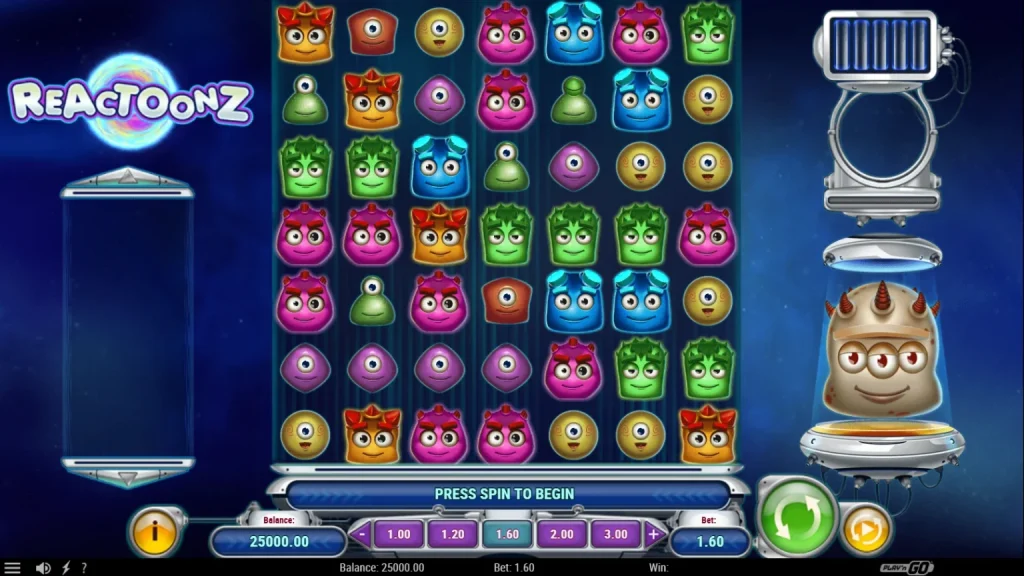
Reactoonz replaces the familiar reel-and-payline rhythm with a square 7×7 field of animated symbols. Five or more matching symbols connected in a cluster can produce a win, after which those symbols disappear and replacements fall from above. Play’n GO describes this process as repeated opportunities within the same round because fresh symbols can create another qualifying cluster immediately after the first one clears.
That cascade structure is the central reason the game can feel uneven in pace. One spin may stop almost immediately. Another may continue through several symbol drops, with each successful cluster extending the sequence.
This grid-based design also places Reactoonz within the broader mechanical style covered by the Play’n GO game portfolio, where understanding the provider’s terminology helps distinguish cluster games from conventional line-based slots.
Cluster wins and cascades
The player is primarily watching for groups rather than symbols lining up from left to right. The visual focus therefore stays in the middle of the grid, where symbols can disappear, new ones can fall, and the shape of the board can change repeatedly during a single round.
Larger or repeated clusters also matter because winning symbols contribute energy toward the game’s feature system. The round therefore has two layers of movement: immediate cluster payouts and progress toward additional grid effects.
The Quantum feature flow
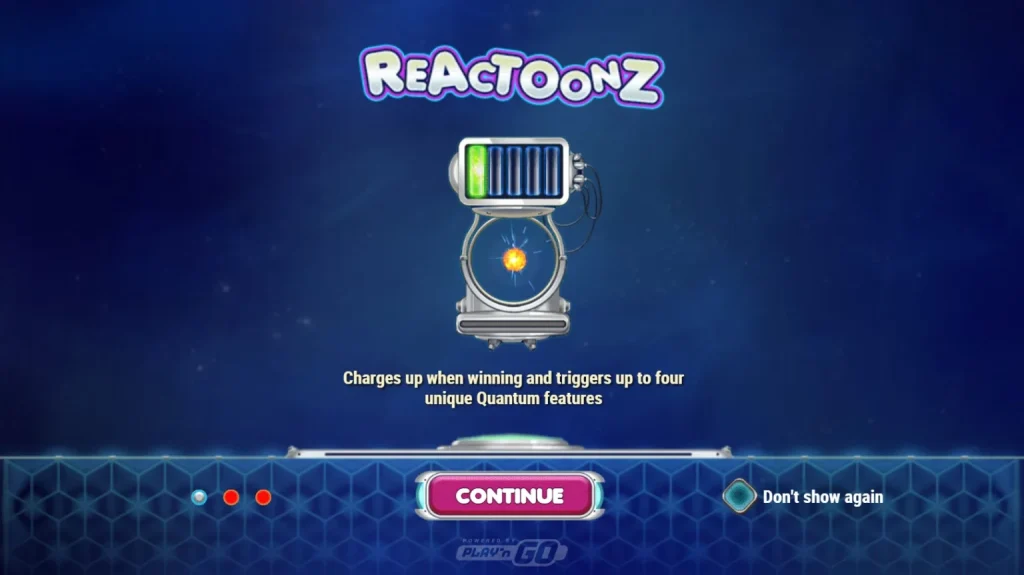
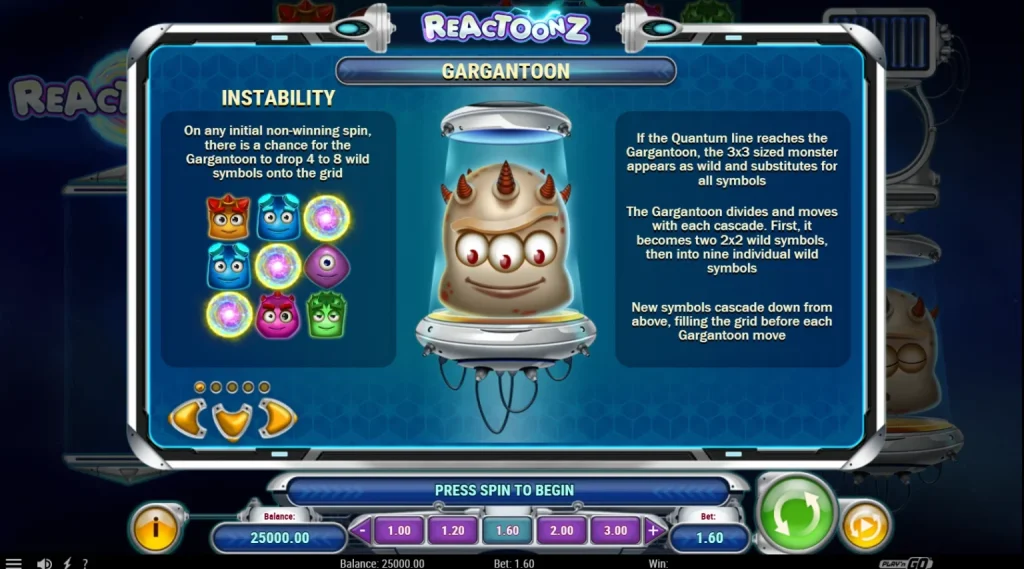
Play’n GO describes Reactoonz as using a charged Quantum system. As winning clusters contribute energy, features can be queued. The provider identifies effects including Demolition, which removes selected symbol groups, and the eventual Gargantoon appearance.
The important gameplay point is not simply the feature names. It is how they change the board.
A removal feature can clear space for another symbol drop. A Wild-generating effect can alter which clusters are possible. Gargantoon can occupy a large portion of the grid as a Wild before changing form through subsequent cascades. These mechanics make feature sequences feel more like extensions of the current grid than separate bonus games.
Readers comparing this structure with other titles can use the Play’n GO slot mechanics to place Reactoonz’s cascades and feature meters in the provider’s wider design context.
What to Check in the Game Rules Screen
Before interpreting a Reactoonz session, the most useful information comes from the rules, paytable, and information panels supplied with the specific game version.
RTP disclosure
Check the displayed RTP rather than assuming every implementation uses the same value.
A widely reported Reactoonz configuration is 96.51%, but secondary documentation also reports lower RTP variants. This means the exact figure should be verified in the game instance being examined rather than copied from a review or database.
RTP also does not predict a short session. The UK Gambling Commission explains RTP as an average developed across a significant volume of play, with ordinary volatility causing results to vary over typical sessions.
The Play’n GO RTP and rules guidance is therefore most useful as context for reading provider information, not as a substitute for the figures shown inside the individual game.
Cluster requirements
Confirm how many matching symbols are required and how adjacency is defined.
For the original Reactoonz, Play’n GO states that a cluster of five or more matching aliens produces a win.
This matters because cluster slots are read differently from fixed-payline games. Instead of scanning for a specific left-to-right line, the player is watching connected groups across the grid.
Cascading rules
Check whether winning symbols disappear and how replacement symbols enter.
In Reactoonz, winning symbols are removed and new symbols fall into the cleared spaces. This is what allows one paid round to develop into several consecutive cluster events.
Quantum features
Review the actual feature descriptions rather than judging a meter only by its visual progress.
Play’n GO’s own Reactoonz material identifies several Quantum effects and describes Gargantoon as the major charged feature.
Understanding those descriptions makes the meter more meaningful because the player can distinguish between simple visual progress and a feature that actually changes the grid.
Volatility information
If volatility is disclosed, treat it as an indication of distribution and session variability, not a timetable for wins.
The UK Gambling Commission notes that volatility is relevant when assessing how actual game results can vary around designed RTP.
A volatile game can therefore produce long stretches that look very different from its theoretical long-run percentage.
Quick Reference Table
| Element | What to verify | What it changes during play |
|---|---|---|
| Grid | 7×7 format | Creates a large cluster-based play area |
| Win structure | Five or more matching symbols | Replaces conventional payline scanning |
| Cascades | Winning symbols disappear | Allows multiple outcomes within one round |
| Wilds | Check Wild behavior in rules | Can connect or extend cluster formations |
| Quantum system | Feature names and trigger conditions | Changes the grid after accumulated winning activity |
| Gargantoon | Exact Wild behavior | Can create a larger board-changing feature sequence |
| RTP | Version shown in the game | Defines theoretical long-run return for that configuration |
| Volatility | Provider or game disclosure, if available | Helps explain why short sessions may swing sharply |
The broader Play’n GO provider overview can provide context for terminology shared across other Play’n GO grid titles, but Reactoonz’s own rules screen remains the primary reference for the version being examined.
Common Mistakes and Misconceptions
Treating RTP as a session target
An RTP percentage is not a promise that a player will receive approximately that percentage back after 10, 100, or even several hundred spins.
It is a theoretical long-run measurement. Short-term results can sit far above or below it because actual outcomes are affected by variance.
Assuming the meter makes the next spin more likely to win
A visible feature meter can create a strong sense of progression, but it should be interpreted according to the written game rules.
Feature progress does not establish a general rule that an unrelated losing spin has made the next random outcome “due.” Treating previous losses as evidence that a win must arrive is a form of gambler’s fallacy.
Confusing cascades with separate paid spins
A cascade sequence can contain several symbol drops, but those drops are part of the mechanic initiated by the original round.
This is one reason Reactoonz can look much faster during a productive sequence than during isolated spins.
Assuming every Reactoonz version has identical RTP
Published reviews do not necessarily describe every configuration. Secondary sources report multiple available RTP settings, so the percentage shown in the actual rules screen is more relevant than a general web listing.
Treating a feature as a winning system
Quantum features can change the grid and create additional combinations, but they do not convert the game into a predictable system.
The sequence remains subject to the game’s programmed mathematics and random outcomes.
Example: Reading RTP Without Predicting a Session
Suppose the game information screen displays an RTP of 96.51%.
That figure should not be interpreted as meaning a 100-unit session will return exactly 96.51 units. Instead, it describes a theoretical return calculated across a very large body of gameplay.
A short session could return substantially less or substantially more. The gap between short-term results and the long-run model is one of the practical effects associated with variance and volatility.
Responsible Gambling Note
Reactoonz is a game of chance. Cascades, meters, Wilds, and charged features can make a session feel as though momentum is building, but visual progression should not be treated as evidence that future outcomes are guaranteed.
If real-money gambling is legally available to a player, predetermined spending and time limits can help separate entertainment decisions from attempts to recover previous losses. Do not increase stakes because a feature appears close, and do not treat earlier losses as a reason to continue.
For South Korea specifically, gambling activity must also be considered within local law. Article 246 of the Korean Criminal Act contains penalties relating to gambling, subject to the circumstances and statutory exceptions, while the National Gambling Control Commission oversees policy concerning regulated and illegal gambling activity. This page does not provide legal advice.
FAQ
Is 리액툰즈 the same game as Reactoonz?
Yes. This page uses 리액툰즈 as its Korean-language focus keyphrase for Play’n GO’s Reactoonz. Play’n GO lists the title as Reactoonz and classifies it as a grid slot with a creatures and science-fiction theme.
Does Reactoonz use paylines?
Its main win structure is based on clusters rather than traditional fixed paylines. Play’n GO states that clusters of five or more matching aliens can form wins on the 7×7 grid.
Does a nearly charged Quantum meter mean a payout is due?
No. The meter explains progress within the feature rules, but it does not establish that future random outcomes must compensate for previous results. The safest interpretation is to follow the written trigger conditions and avoid treating visual progress as a prediction of profit.
Resources
- Play’n GO, Reactoonz Slot Demo.
- Play’n GO, Reactoonz Review: The Evolutionary Beginnings of Play’n GO’s Electrifying Series.
- National Gambling Control Commission, Republic of Korea, Gambling Industry Policy & System.
- Statutes of the Republic of Korea, Criminal Act, Article 246: Gambling and Habitual Gambling.
- Fruity Slots, Reactoonz Demo & Review | Play’n GO