Quick Answer
글루터니 is the Korean keyphrase used for NoLimit City’s “Gluttony,” a 5×5 slot built around a sticky, multiplier-heavy feature set where most of the session texture comes from when the game shifts into its bell-driven bonus modes. The clearest, session-relevant facts are the in-game rules and the exact version running where you play, because some features (like bonus buys) can be restricted in regulated environments.
Key Takeaways
-
The base game can feel like a setup phase, the big swings are concentrated in the bell-triggered feature rounds.
-
RTP is a long-run design metric, it does not describe what should happen in a short session.
-
The game’s stated max payout cap changes how extreme a “peak moment” can be, even in a strong bonus run.
-
Bonus buy options may exist, but can be removed in some regulated markets, which changes the practical pace of seeing features.
-
If you are setting limits, assume variance can stretch quiet periods longer than they feel, then compress the session’s story into a few bursts.
Definition
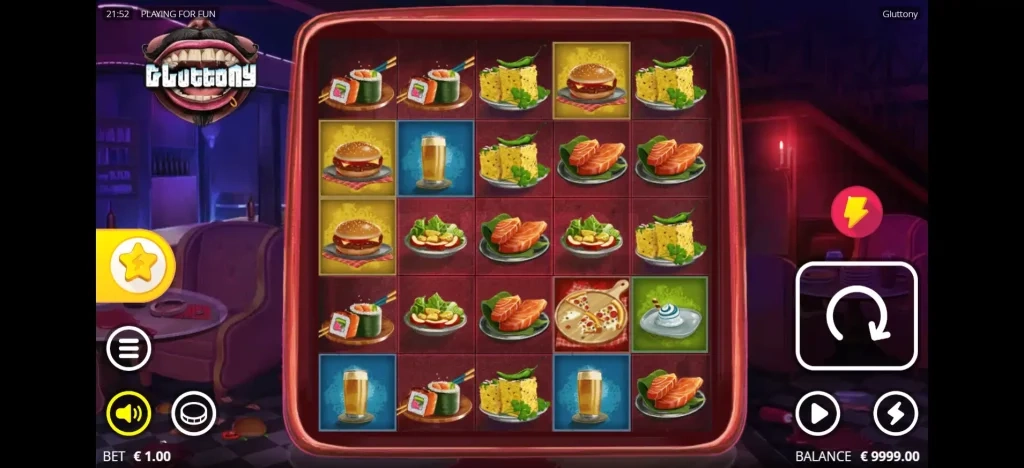
글루터니 (Gluttony) is a NoLimit City slot released on June 6, 2023, presented on a 5×5 grid with disclosed stats on the studio’s page, including RTP (listed as 96.09%), hit frequency, and a stated max payout cap. Exact settings can vary by version or environment, so confirm what your rules screen shows before treating any number as fixed.
What It Means / How It Works
This game’s pacing is easiest to understand as two different gears.
The first gear is the steady spin loop, where you are mostly watching for the symbols that start the bell-driven modes. That “waiting room” feeling is part of the design in many NoLimit City titles, and NoLimit City provider overview helps frame why the base game often feels like it is building toward a feature rather than constantly paying in small, frequent taps.
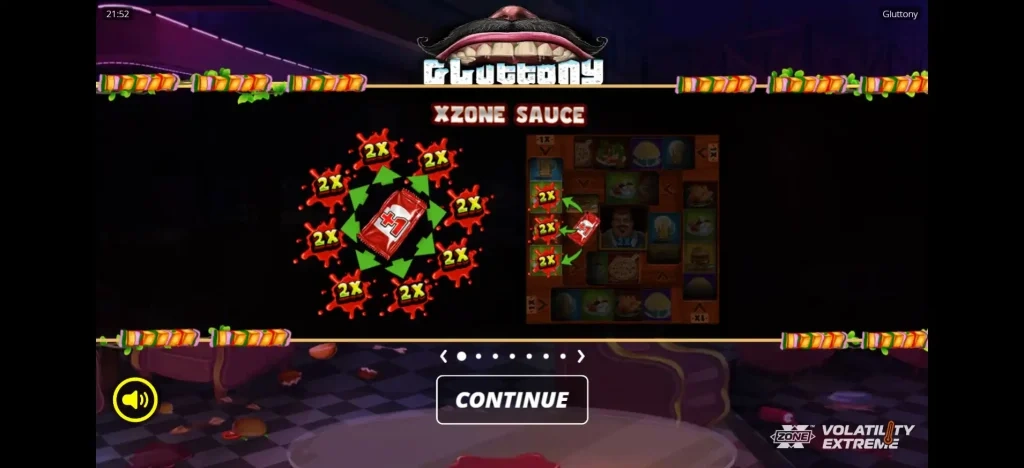
The second gear is the feature layer, where multipliers and collection effects can make outcomes feel more concentrated. In Gluttony’s case, the studio highlights a signature multiplier mechanic called xZone Sauce, alongside named free spins modes like Order Up!, Double Up!, Quadruple Up!, plus the higher-intensity FEDCON 1 mode. When you enter these sequences, the session can flip from quiet to chaotic quickly, because the feature rules actively change how multipliers attach, grow, or persist.
What to Check in the Game Rules Screen (Practical, Non-Promissory)
These checks are about matching expectations to what the game actually states on your screen, not predicting results.
-
RTP and any version notes
-
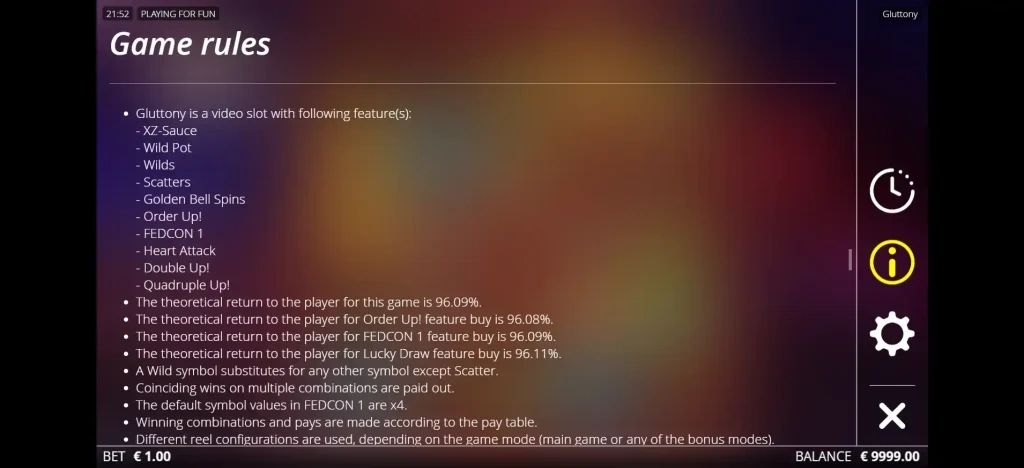
The NoLimit City page lists RTP as 96.09%, but your most reliable reference is the rules screen for your specific build.
-
Third-party testing services commonly describe RTP as something evaluated against the theoretical design over very large samples, which is why it should be treated as a long-run metric, not a session forecast.
-
A useful habit is comparing how NoLimit City RTP and volatility disclosures are presented across titles, because the same “what matters” fields tend to repeat.
-
-
Volatility signals and swing expectations
-
The studio page explicitly shows volatility as a headline field, even if the exact label is not spelled out in the snippet view. Read it as a warning about distribution, long quiet stretches can happen, and the meaningful moments may arrive in clusters.
-
If your rules screen adds wording about volatility or risk, treat that as the most relevant guidance for how the session will feel.
-
-
Feature names and trigger conditions
-
Gluttony uses two scatter types, Silver Bell and Golden Bell, with different reel placement rules and different paths into free spins.
-
The rules explain how combinations of bells map into specific modes (Order Up!, Double Up!, Quadruple Up!, and FEDCON 1), and these names matter because each mode changes pacing and multiplier behavior.
-
-
How multipliers actually attach
-
xZone Sauce adds +1 multiplier value to adjacent symbols and wilds in multiple directions, and the allowed placement can change during FEDCON 1. Those restrictions affect the “shape” of wins in features, because they change where multiplier growth can happen.
-
Wild Pot behaves like a collecting wild that can grow by pulling in nearby symbols, which tends to make some feature spins feel like they either fizzle quickly or suddenly stack into a heavier outcome.
-
-
Caps and hard limits
-
The Heart Attack rule states the max payout is capped at 32,000x base bet, and if the total win exceeds that amount, the round ends at the cap. That single line changes how to interpret the far end of the volatility spectrum.
-
-
Bonus buy availability
-
The studio lists a “Nolimit Bonus” feature-buy function, but also notes it may be removed in some regulated markets. If that option is absent, the practical cadence of seeing FEDCON 1 shifts back to pure natural triggers, which can feel slower and more uneven.
-
When you are comparing how that impacts pacing across games, NoLimit City bonus buy availability and limits is the right mental model, because the key question is not the price, it is whether the session can access features directly at all.
-
Light Support Block: Quick Reference Table
| What to verify | Where it appears | What it changes in play |
|---|---|---|
| RTP shown for your build | Rules, paytable, help | Long-run framing, avoids false certainty |
| Scatter rules (bell types) | Rules, feature info | Feature cadence, how often pacing shifts |
| Mode names and effects | Rules, feature info | What “a bonus” actually does in-session |
| Multiplier mechanics | Rules, xZone, Wild Pot | How wins cluster and grow inside features |
| Max payout cap | Rules, Heart Attack section | Ceiling of spike events, expectation control |
| Bonus buy presence | Lobby options, rules notes | Practical speed of feature access |
Common Mistakes / Misconceptions
-
Confusing RTP with what “should” happen tonight
-
RTP is a statistical, long-run concept. A single session can land far above or below it due to variance, even when the game is working normally.
-
-
Assuming a feature is due after a dry stretch
-
Quiet runs are compatible with high variance. Treat streaks as normal outcomes, not signals.
-
-
Treating multiplier-heavy features as predictable
-
Mechanics like adjacency multipliers and collecting wilds can create very uneven distribution, many feature entries are modest, and a few define the whole session.
-
-
Skipping the cap language
-
A stated cap is not trivia. It is the boundary condition for the most extreme outcomes, and it should shape expectations about how “far” a run can go.
-
-
Misreading RNG badges
-
Testing labs describe RNG and game testing as verification work aligned to technical requirements and audit expectations. It supports fairness checks, not “patterns you can exploit.”
-
Examples (only if directly clarifying)
-
Why two bonus rounds can feel unrelated
-
In one entry, you may get the mode but fail to build multipliers or collections, so the bonus feels brief and flat. In another entry, xZone placement and Wild Pot collection chain together, and the same mode feels explosive. The rules define what is possible, not what is typical.
-
-
Why the cap matters for interpreting “extreme volatility”
-
A cap like 32,000x sets a hard ceiling. Even when a feature looks like it is escalating, the rules can force the round to end at the maximum payout.
-
Responsible Gambling Note
If you are using this guide to plan session limits, keep the control points simple. Set a time limit and a spend limit before you start, then treat quiet stretches as normal variance rather than a reason to chase. In South Korea, Korea Problem Gambling Agency provides support and counseling, including the nationwide helpline 1336.
FAQ
Is the RTP for 글루터니 always the same?
Not necessarily. RTP can be shown as a specific value for a given build, but settings can differ by version or environment. The RTP displayed in your rules screen is the one relevant to your session.
Does higher volatility mean worse odds?
No. Volatility describes how returns are distributed over time, not the long-run expected return by itself. A higher-volatility slot can feel swingier, with longer gaps and sharper spikes, even if RTP is similar.
Where should I start if I want to understand NoLimit City slots as a group?
A provider-first view helps because UI patterns, disclosure habits, and feature naming often repeat across a catalog. In that context, NoLimit City game catalog and formats supports comparing what you see in one title against the studio’s broader style.
Resources
-
NoLimit City, “Gluttony Slot, RTP, max payout, feature rules”
-
eCOGRA, “RTP Percentage Testing”
-
iTech Labs, “iGaming Testing and Certification Services (RNG testing and audit)”
-
Gaming Laboratories International, “GLI-19 Standards for Interactive Gaming Systems (PDF)”
-
Korea Problem Gambling Agency, “Overview (National Gambling Helpline 1336)”