Quick Answer
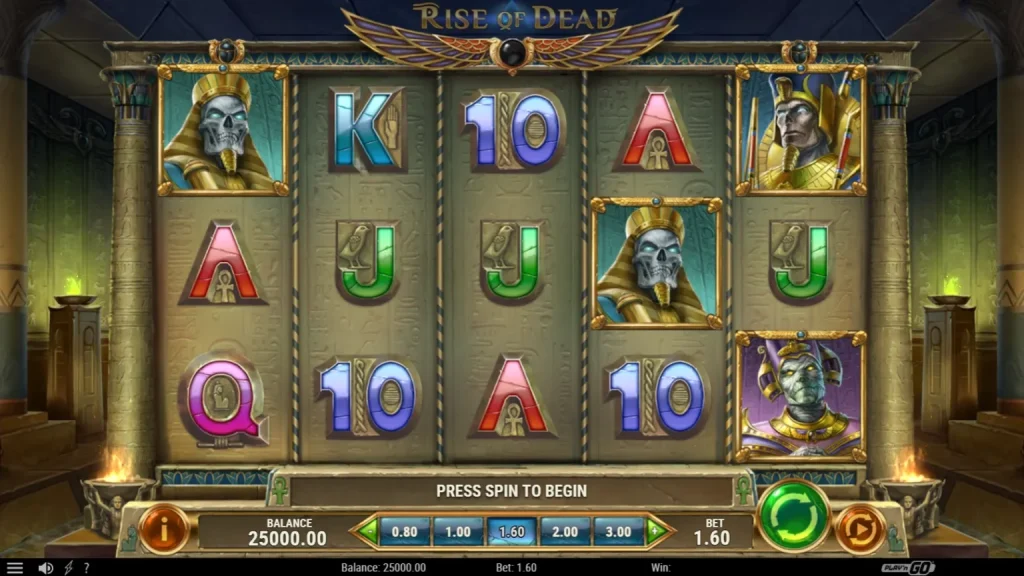
라이즈 오브 데드 is a PLAY’n GO video slot with an Egyptian tomb theme, a 5 reel by 3 row layout, 20 paylines, reported high volatility, and a default RTP commonly listed as 96.53%, though RTP can vary by version, market, or operator.
For South Korea focused readers, the main value of this guide is not where to play. It is understanding what the game feels like in motion, how its stacked-symbol rhythm changes the base game, why the bonus round can feel swingy, and what to verify in the rules screen before interpreting any session result.
Key Takeaways
- 라이즈 오브 데드 is built around stacked-symbol play, so the base game can look busy even when outcomes remain unpredictable.
- The commonly reported default RTP is 96.53%, but the version shown in a game rules screen should always be treated as the source of truth.
- Volatility is usually described as high, meaning quieter stretches and sharper win swings are both part of the expected gameplay profile.
- The main feature labels to check are Mega Stacks, Gift of Gods, and Ancient Free Spins.
- Bonus rounds can extend through retriggers, but this does not make any individual session predictable.
- South Korea readers should treat this as educational content only and avoid assuming availability, legality, or access from international review pages.
What It Means / How It Works
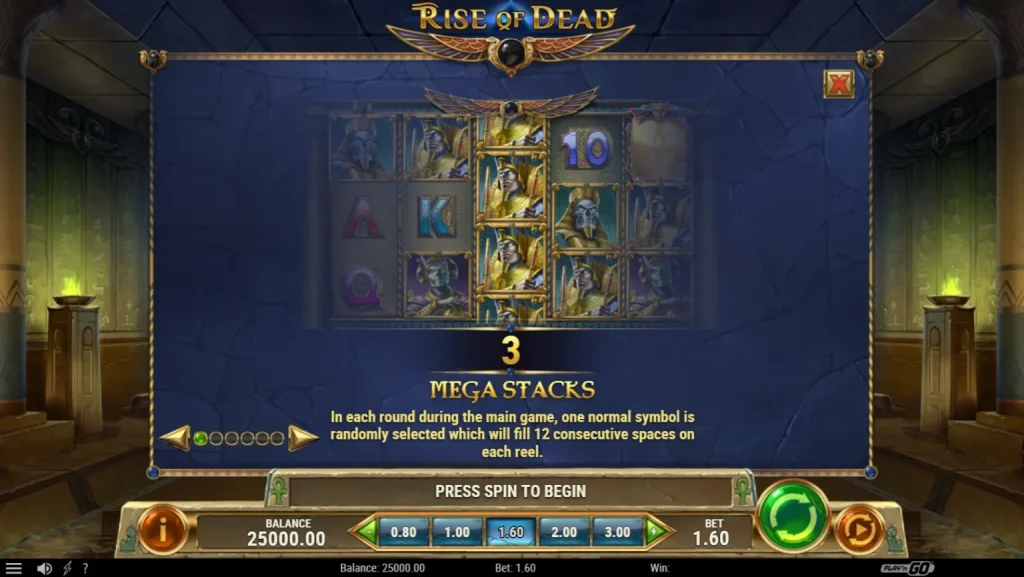
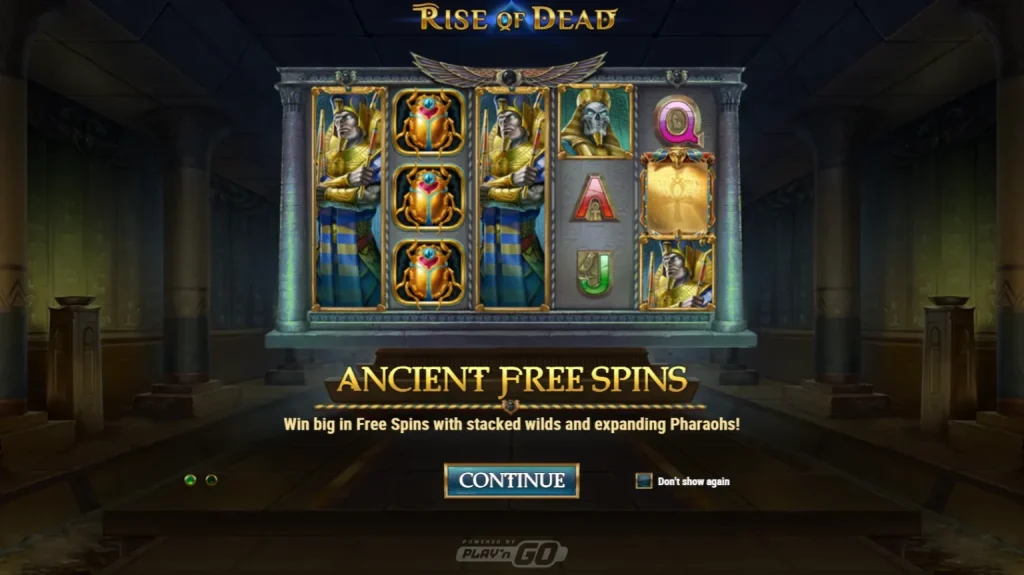
라이즈 오브 데드 plays like a feature-heavy tomb slot rather than a plain line-matching game. The screen uses a familiar 5 by 3 setup, but the rhythm feels more active because stacked symbols are part of the core design. Instead of waiting only for scattered bonus symbols, the player sees tall symbol blocks appear during ordinary spins, which gives the base game a more dramatic visual cadence.
The main gameplay idea is simple. Regular spins can produce stacked-symbol moments, the Gift of Gods feature can interrupt the base game with a short reel-hold sequence, and Ancient Free Spins shifts the pace into a more volatile bonus mode. In a PLAY’n GO gameplay overview, this kind of structure fits the provider’s broader style of pairing simple reels with memorable feature labels.
The most important point is that feature density does not remove randomness. A game can look active, with stacks and bonus teases, while still producing uneven short-term outcomes. That is especially relevant for South Korea focused readers who may be researching gameplay terms in English or Korean and comparing several international summaries.
What to Check in the Game Rules Screen
Before interpreting 라이즈 오브 데드, check the rules screen carefully. The review pages available online can help explain the game, but the live game rules screen is where version-specific information should be verified.
- RTP wording: Look for the displayed RTP in the actual game version. The commonly listed default is 96.53%, but some games can have different RTP configurations depending on market or operator.
- Volatility or variance label: If disclosed, high volatility means the game is designed around less predictable short-session pacing, with the possibility of longer gaps between meaningful hits.
- Payline structure: Confirm the 20-payline setup and how wins are counted. This matters because stacked symbols can cover multiple rows but still need to connect according to the paytable rules.
- Mega Stacks: Check how the stacked symbols are selected and how they appear. This feature affects the base game’s visual rhythm more than it guarantees any result.
- Gift of Gods: Confirm whether the rules describe a random base-game feature involving held reels and respins. This is one reason the game can feel sudden and stop-start.
- Ancient Free Spins: Check the trigger condition, starting spins, retrigger rules, and expanding-symbol behavior. This is where the game’s volatility can feel most concentrated.
- Maximum win or cap: If listed, treat the cap as a limit, not as a likely outcome.
Because PLAY’n GO slot rules and feature design often uses branded feature names, reading the paytable slowly is more useful than relying on theme alone. A tomb theme, stacked reels, and a dramatic bonus screen do not explain the mathematics by themselves.
Quick Reference Table
| Area to Check | What It Tells You | Gameplay Meaning |
|---|---|---|
| RTP | Long-run theoretical return percentage | Useful for comparison, not for predicting a session |
| Volatility | Risk and payout distribution style | High volatility can mean sharper swings |
| Paylines | How wins are evaluated | Stacks still need valid line connections |
| Mega Stacks | Base-game stacked symbol behavior | Makes ordinary spins feel more eventful |
| Gift of Gods | Random feature behavior | Can interrupt the base game with sudden reel action |
| Ancient Free Spins | Bonus trigger and retrigger rules | Shifts the game into a more swing-heavy phase |
| Max win cap | Upper payout limit | A ceiling, not an expectation |
Common Mistakes / Misconceptions
A common mistake is reading RTP as a short-term forecast. RTP is a long-run theoretical measure across a very large volume of play. A single session can finish far above or far below that figure.
Another mistake is treating high volatility as a promise of larger wins. High volatility describes distribution, not destiny. The game can produce long quiet stretches, small line wins, dramatic-looking stacks that do not connect, or a bonus round that ends without a major outcome.
Players also sometimes overvalue visual activity. 라이즈 오브 데드 can look busy because stacks, scarabs, scrolls, and expanding symbols create strong screen movement. That does not mean the game has become easier to predict.
Finally, avoid any claim that a spin pattern, time of day, manual stopping, or recent result can influence the next outcome. Slots are designed around random outcomes, and past results do not create a reliable signal for future spins. For a broader explanation of these basics, Casino Playing Basics can support readers who are new to RTP, variance, and session limits.
Example: How Variance Can Feel
Imagine two sessions with the same stake size and the same displayed RTP.
In one session, stacks land often enough to create small and medium line wins, but the bonus does not trigger. The session may feel visually active without producing a major swing.
In another session, the base game may feel dry, then a free spins round appears and changes the entire pace. If retriggers occur, the bonus can last longer and feel more dramatic. If they do not, it can end quickly.
Both patterns can fit a high-volatility slot. The difference is not evidence that the game is warming up or cooling down. It is the normal unevenness of chance-based play.
Responsible Gambling Note
라이즈 오브 데드 should be approached as entertainment content, not as a financial activity or a way to produce income. High-volatility gameplay can make sessions feel emotionally sharp because results may arrive in bursts.
Set a session limit before play, avoid increasing stakes to chase losses, and stop if the game begins to feel stressful. South Korea focused readers should also remember that gambling rules and access conditions vary by jurisdiction, and this article does not provide legal advice or access guidance.
FAQ
Is 라이즈 오브 데드 a high-volatility slot?
Yes, available review sources commonly describe 라이즈 오브 데드 as high volatility. In gameplay terms, that means outcomes may feel uneven, with quieter stretches and occasional sharper feature-driven swings.
What are the main features in 라이즈 오브 데드?
The main reported feature labels are Mega Stacks, Gift of Gods, and Ancient Free Spins. These features shape the game’s pace by adding stacked symbols, random base-game interruptions, and a bonus round with retrigger potential.
Does the reported RTP guarantee a return in one session?
No. The commonly reported default RTP is 96.53%, but RTP is a long-run theoretical figure. It does not predict what will happen in a short session, and the displayed RTP should be verified in the actual game rules screen.